

AMSTERDAM: Highest Tourist Tax in Europe
Population: 1.2 million

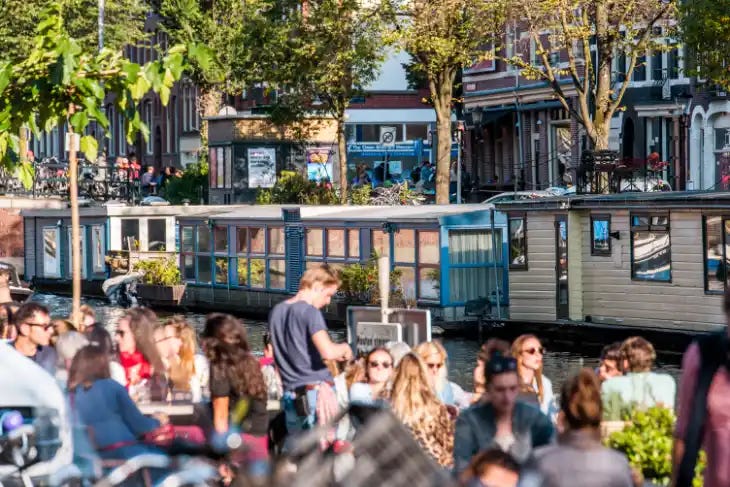
Amsterdam’s centuries-old city center has tourism problems much like those of Paris, such as overcrowding and disgruntled inhabitants. However, there are two important differences.
First, Amsterdam is a city of canals – and while pedestrian overflow on the sidewalks of Paris can be accommodated in the streets, one cannot stroll on the water in Amsterdam’s canals. Second, Amsterdam’s welcoming counter-culture public image had eroded to such an extent that residents and city officials alike complained the city was attracting too many visitors seeking freedom without rules.
Provisional figures from Statistics Netherlands for 2025 show that the Netherlands’ accommodation sector hosted 52.2 million guests across hotels, campsites, and holiday parks, up nearly two percent from 2024. International guests accounted for 22.3 million of these, an increase of about five percent.
Public-Private Partnership
The public-private agency amsterdam&partners is tasked with shaping and guiding the Amsterdam Metropolitan Area’s cultural, visitor, and economic ecosystem. “The biggest challenge has been changing the narrative around Amsterdam and changing visitor behavior along with it,” a spokesperson told Reporting from Paris. “For years, the city’s reputation attracted a type of tourism that wasn’t always adding value: high volume, concentrated in a small area of our historic center, and focused on a very narrow set of attractions. Shifting that takes sustained effort.
“Our recent campaigns are about dismantling the clichés and showing the city as it really is,” she added. “Creative, diverse, layered, and spread across many neighborhoods worth discovering.”
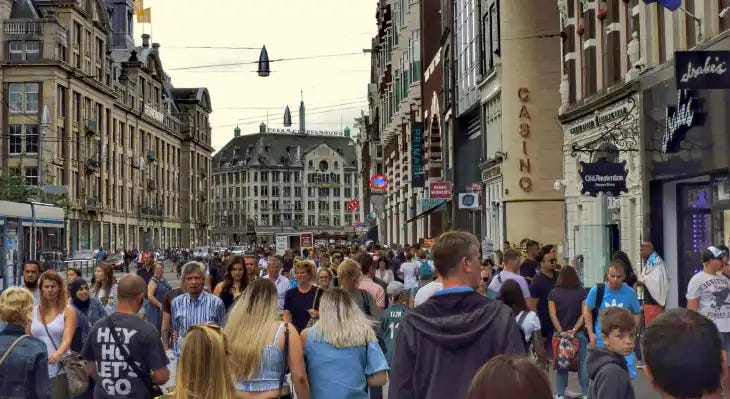
In 2020, a citizens’ initiative was launched, gaining more than 30,000 signatures, called “Amsterdam has a Choice.” This resulted, the year after, in a formal agreement with the city to cap the number of overnight visitors at 20 million per year – a figure that is lower than the capacity.
As part of this, technology tracks visitor stays and triggers an early warning when the number reaches 18 million. That, in turn, functions as a policy trigger to the municipality to tighten regulations, further regulate market messages, or deploy behavioral-change communications campaigns. Those in the recent past have carried such blunt slogans as “Stay Away” and “Amsterdam Rules.”
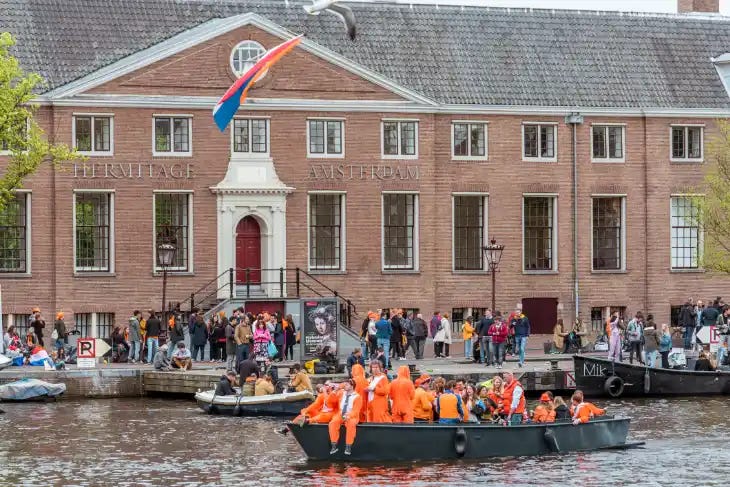
In addition to the tourist cap, Amsterdam developed its digital “Tourism in Balance” approach to keep both tourists and residents happy. Measures implemented include a mix of hard and soft policies:
HARD MEASURES
The highest tourist tax in Europe: 12.5 percent of the accommodation price (excluding VAT).
Day tourist tax: €15 per passenger.
Restrictive approval for new short-term rentals.
A ban on hotel expansion.
A reduction in river cruise permits issued from 2,300 to 1,150 annually; sea-cruise stop-overs capped at 100 per year; disembarkation fee raised from €8 to €14.
Ban on tourist buses in the historic center.
SOFT MEASURES
Research to identify problematic behaviors (nighttime noise, stag- and hen-group disruptions).
Regulatory curbs in high-pressure areas (Red Light District): bans on public cannabis smoking; tighter licensing and closing-hour restrictions.
A newer awareness-driven campaign, “Renew your view,” to promote respectful conduct and redirect visitors to off-peak times or alternative sites.
Promotion of nearby destinations (e.g., Zandvoort, the “Amsterdam Beach”) and other Dutch attractions to diffuse central-area pressure and extend the tourism season from spring through autumn.
Losing the Numbers Game
But something’s not working. According to news broadcaster AT5, official government statistics show that, despite everything, the number of tourist overnight stays in the city continues to increase. A total of 23.7 million overnight stays were recorded in 2025 – about 800,000 more than in 2024 – and is expected to continue growing until 2028, though at a slower pace than in the 2015–2019 period.
Nevertheless, because the tourist cap is constantly being exceeded, “Amsterdam has a Choice” filed a lawsuit against the city last year, demanding harsher measures – such as raising the already high tourist tax. The case is still being debated. However, as Reporting from Paris was going to press, the government had just announced dramatic new proposals to manage tourism, including an increase in the tourist tax to 16 percent next year – rising by one percent every year until it reaches 20 percent.
For the near-term, the amsterdam&partners spokesperson says the focus is on keeping the increase in tourists on a downward trajectory, and encouraging visits to other regions of the Netherlands, easily accessible by train. “For the summer ahead, we expect strong demand. Amsterdam remains one of Europe’s most compelling destinations. Our focus is on guiding that interest in the right direction: spreading visitors across the city and the wider metropolitan region, and making sure everyone who comes understands that this is, first and foremost, a city where people live and work.”
Having worked for amsterdam&partners for many years (when tourism needed promotion), I know how difficult it is to steer (decrease) the huge amount of visitors. Amsterdam is the most beautiful city in Europe (my humble and objective statement). But the historical centre is very small and quite fragile.
We love to welcome visitors and are proud of our city, but there are boundaries - large groups partying and misbehaving, rental prices are skyhigh. It is difficult to find the right balance. The new local government has decided to gradually increase tourist tax to 20pct - right now with 12.5pct already the highest rate in Europe. This extra income should be used to cover costs of overtourism. Hotel owners are, as was to be expected, furious. Action group AmsterdamHasAChoice, however, wants to see this tax as high as 32 pct. Our local newspaper Het Parool is publishing new articles and letters to the editor on a daily basis. The best solution for the overtourism problem (for which ‘all of us’ are to blame) has not yet been found…
As a regular visitor to both capitals over many decades , my view is that there is nothing more effective to keep tourists away than simply making them ‘feel’ they really aren’t welcome anymore . All of the measures you describe achieve that very effectively. I for one will be spending my money elsewhere from now on so no doubt hope they can consider this a great success !