

Three months and 23 days after signing the Declaration of Independence in Philadelphia, Benjamin Franklin set sail for France, arriving in the city of Nantes to an enthusiastic welcome, embarking on what biographer Walter Isaacson terms “the most dangerous, complex, and fascinating of all his public missions.” Franklin was to obtain an alliance with France that would help the 13 rebellious American colonies win independence from Britain. Not an easy task, as France had just lost most of its American holdings in the Seven Years’ War against Britain and was more concerned with replenishing its coffers than giving money to insurgent Americans.
Franklin was no stranger to France or to the French court. His first mission, ten years previous, was very different. From his base in London, where his job was to represent colonial interests to the British government, Franklin crossed the Channel several times. In 1767, he spent some six weeks touring France, meeting the country’s scientists, philosophers, and intellectuals, and making contacts that would prove useful in 1776 when he would arrive asking for aid.
As a consequence, Franklin was enthusiastically welcomed at court and by the country’s influential figures in 1776, who knew him not as a rebel but as one of Europe’s most distinguished scientists and who had been admitted in 1772 to the prestigious French Academy of Sciences. Such was his fame that on his arrival in Nantes, he was fêted with a ball, and en route to Paris, he left ladies in his wake styling their wigs à la Franklin, inspired by his soft fur hat.
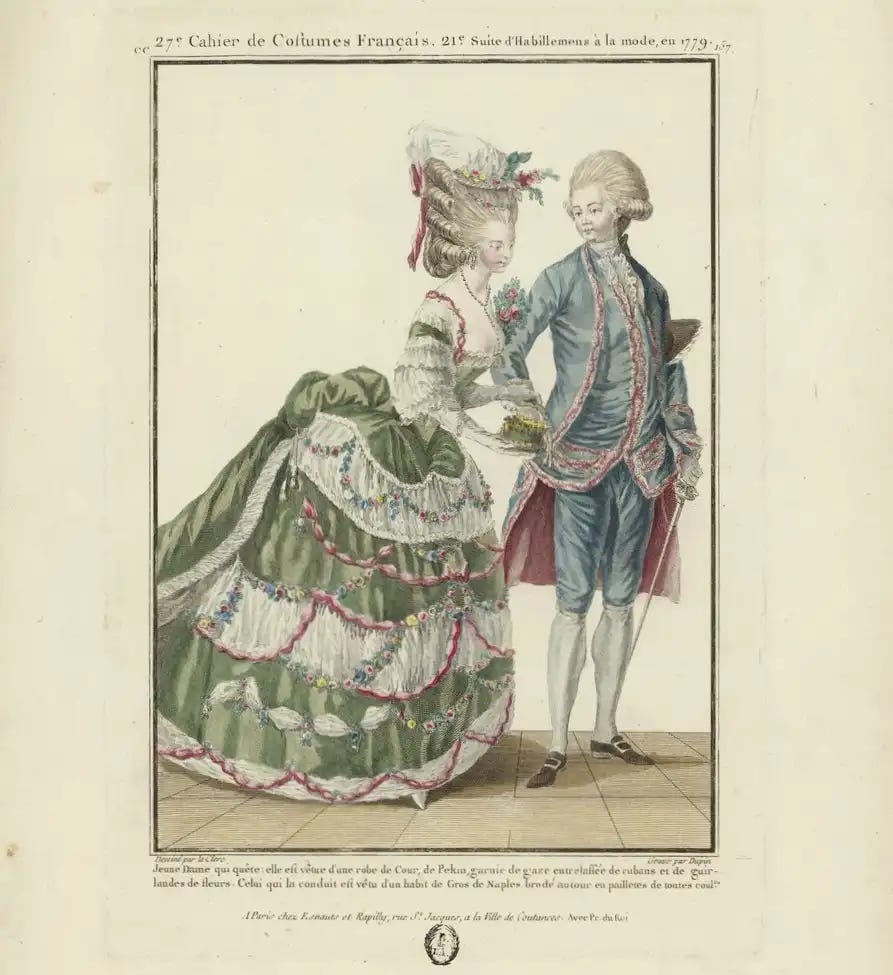
Fashion at Court was Formidable
La mode was serious business in 18th-century France. Luxury artisans and merchants along the Rue Saint-Honoré furnished the court, while the nascent fashion press, largely concentrated in Paris, brought elite fashions down the social ladder and abroad, as Denis Bruna and Chloé Demey observe in their book Histoire des Modes et du Vêtement. Indeed, Lyonnais silk manufacturers – who pioneered the system of releasing new models each season that would come to define the fashion industry – were esteemed across Europe.
Fashion ruled life at Versailles, where entire offices were consecrated to the royal wardrobes and ensembles communicated not only the status of their wearers but reflected that of those around them. However, the Benjamin Franklin greeted by the French in 1776 was very different from the one they had met, dressed à la française, in 1767.
Whereas in 1767, Franklin presented the image of a courtier (which he was not), he now sought to portray himself as a Quaker (which he also was not). He had swapped complicated French etiquette for American simplicity, and he made it clear in what he wore: exchanging the powdered wigs and silk vests from his initial French visit for unadorned, soberly colored coats, and pants, and swapping a wig for a plain hat atop his own natural, thinning grey hair. “Think how this must appear among the Powder’d Heads of Paris!” proclaimed the Founding Father in a letter, reflecting upon his strikingly modest appearance. Through his simplicity of style, Franklin sought to personify the American spirit – exceptionalism, universalism, integrity, a certain purity – to help succeed in his mission to win French support.
In 1767, Franklin wanted to fit in; in 1776, he wanted to stand out.
Clothes Make the Man
It worked. Framing the revolutionary effort as ideological, with virtue as important as gunpowder, Franklin dressed the part of “noble frontier philosopher and simple backwoods sage.” Fashion already signaled influence and virtue in French society: he simply flipped the script.
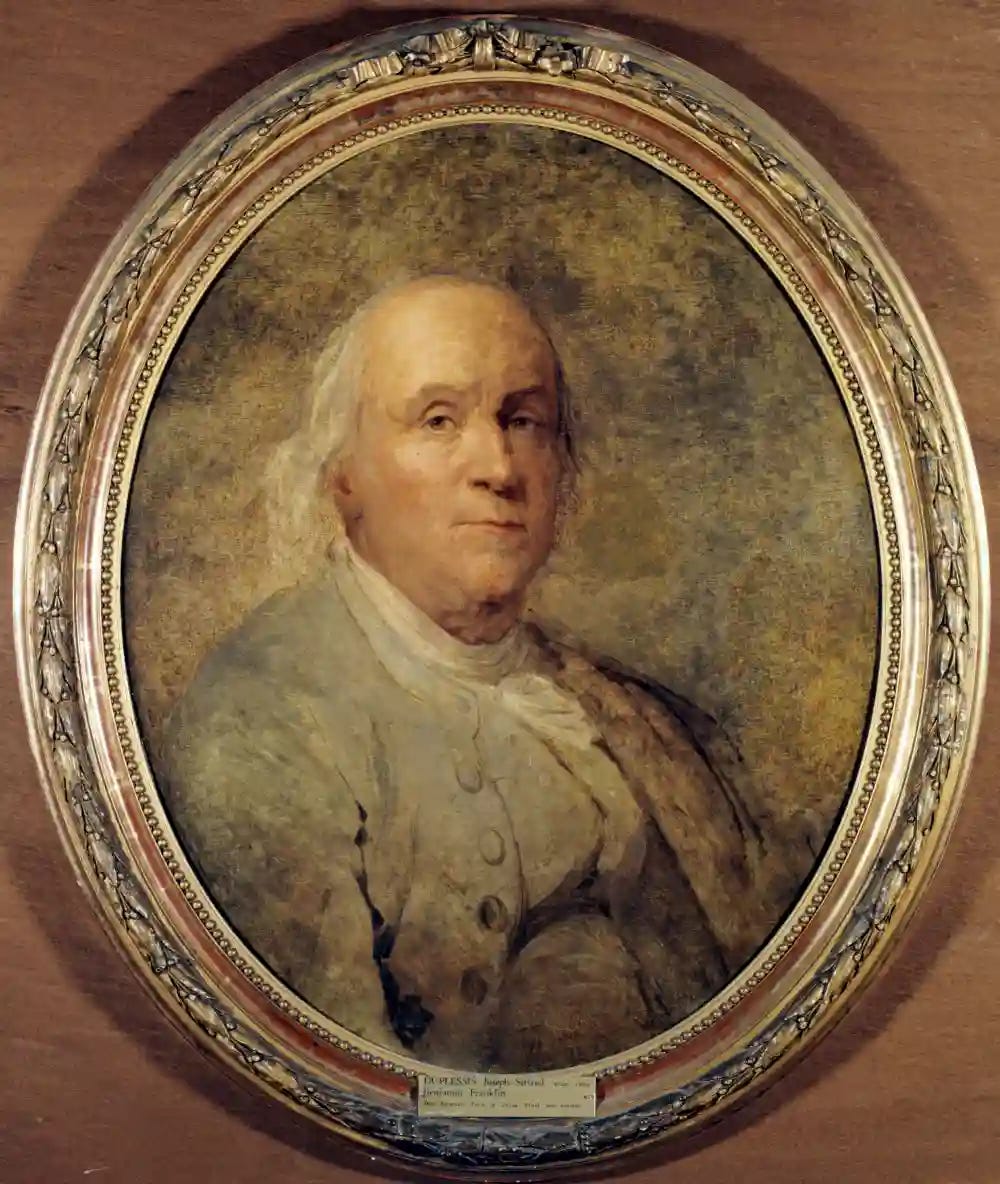
Against the lace and frills, diamonds and pearls, silver and gold, and meter upon meter of many-hued velvet and silk adorning the elite members of court, the severely dressed American was downright exotic. Marie-Antoinette’s première femme de chambre, Madame Campan, recalled how Franklin’s “flat, unpowdered hair, his round hat, and his brown suit contrasted with the embroidered, sequined ensembles and powdered, perfumed hairstyles of the courtiers.”
The change was more than cosmetic, and it was not lost on the court or the wider French society. Franklin’s overall style appealed to followers of The Enlightenment as well as to those at the highest echelons who were beginning to talk openly about liberté, égalité, and fraternité.
Diplomacy in a Plain Suit
But while Franklin’s mode of dress sent a clear message of American idealism and ambition, it was not quite measuring up to the realism of going to war… until the British were soundly defeated by the American rebels in the Battles of Saratoga in September and October of 1777. The French began to believe the rebels had a real chance to defeat their age-old rival, the British. Two treaties were signed in February of the next year: one of friendship and commerce, and the other a treaty of alliance, in which France formally recognized the independence of the United States and agreed to join them in their war against Britain.
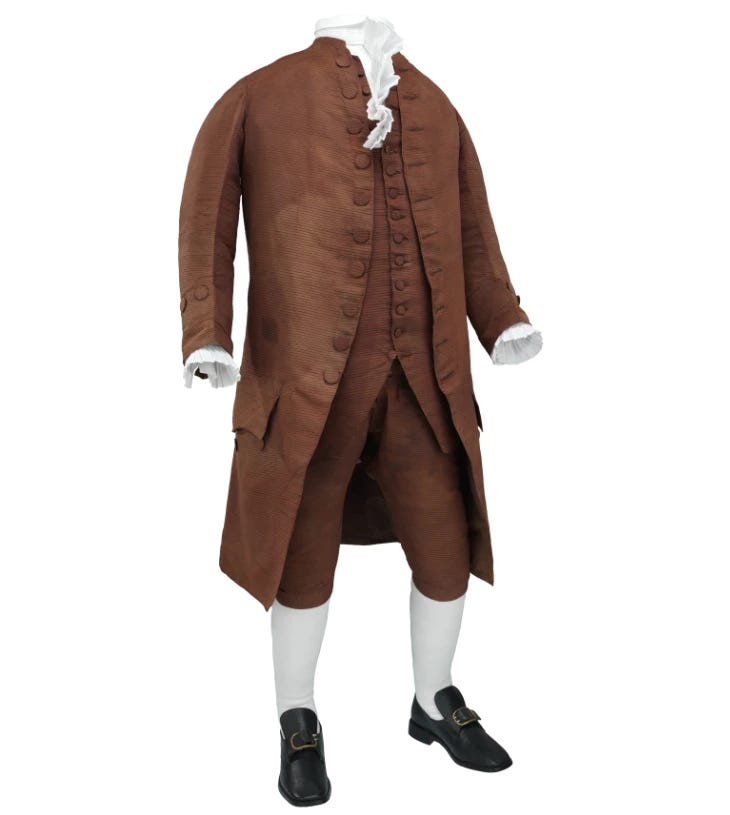
With that alliance secured, Franklin had a final fashion statement to make at the reception at Versailles in March 1778, officially celebrating the signing of the two treaties. While his co-commissioners wore official court dress and the swords typically required within the palace walls, fashion rules didn’t apply to Monsieur Franklin. Standing out against courtiers in ceremonial garb – outfits that could cost more than a laborer earned in 30 years – France’s favorite American opted for his standard brown suit. Instead of a sword, he simply accessorized with his spectacles.
He did, however, lose the fur cap in favor of a white hat. In France, white was the color of royalty. But Franklin made it a symbol of liberty. “Whether or not he meant it to be,” asserts biographer Walter Isaacson, “white hats for men were soon in vogue in Paris, as everything else Franklin wore was wont to become”.
Franklin had used fashion to support a new way of thinking and changing politics. In so doing, he turned the world on its head, securing the French military and financial support the colonies needed to defeat the British at Yorktown in 1781… and helping to set the stage for the revolution that was to take over France in 1789.
Works referenced:
Denis Bruna and Chloé Demey, Histoire des Modes et du Vêtement (Paris: Éditions Textuel, 2018)
Jeanne-Louise-Henriette Campan, Mémoires sur la Vie Privée de Marie-Antoinette, Reine de France et de Navarre, Suivis de Souvenirs et Anecdotes Historiques sur les Règnes de Louis XIV, de Louis XV et de Louis XVI (Paris: Baudouin Frères and Mongie l’Aîné, 1822)
Walter Isaacson, Benjamin Franklin: An American Life (New York: Simon & Schuster, 2004)
