

Swatch Launch: Chaos, Crowds & Controversy
The riotous launch of the Audemars Piguet-Swatch pocket watch last month generated huge crowds, publicity, and bigger sales. Was it worth it?


At a Swatch store in the Paris region, more than 300 people assembled early to be among the first in the door for the May 16 launch of the Audemars Piguet x Swatch “Royal Pop.” France24 reported that police ended up using tear gas to disperse that crowd. In addition, four persons were assaulted in a crowd outside a store in Lille.
These were not the world’s only mob scenes that day: from Paris to Singapore to New York came reports of fights among customers, police intervention, and some stores refusing to open amid safety concerns. Newspapers, watch publications, and social-media commentators criticized the handling of the launch, arguing that the companies should have been better prepared for the crowds. Municipal officials in some locations questioned the public cost of deploying police and other resources to manage the disorder.
Rather than apologizing, Swatch Group CEO Nick Hayek Jr. characterized the launch as a success, emphasizing that only a small percentage of the more than 200 participating stores experienced significant disruptions. “Having crowds at the beginning of the launch of [a] product should not be bad news,” he told the BBC on May 19th. “It should be something that is good news.”
Price of Publicity?
At first glance, describing the violence and closures at Swatch stores as a success would be like Jeff Bezos saying that the recently failed launch of a Blue Origin rocket was successful because its fiery explosion was spectacular to watch. However, from a marketing perspective, particularly when you view the Royal Pop not so much as a watch launch, but as a demonstration of how modern desire is created, it could be seen as a success.
Luxury brands once relied primarily on exclusivity, craftsmanship, and advertising to generate demand. Today, participation itself has become part of the product experience. The overnight queue becomes part of the story. The social-media post becomes part of the story. The hunt becomes part of the story.
By that measure, the Royal Pop succeeded spectacularly.


The collaboration dominated watch media, mainstream news outlets, fashion publications, and social-media feeds. It sparked debate among collectors and enthusiasts while generating enormous demand. Inventory sold out almost immediately, and secondary-market prices surged as some who queued to be among the first in store admitted they had already lined up buyers ready to pay several times the initial price.
Online watch marketplace Chrono24 reported on June 3 that resale activity was beginning to normalize after an initial frenzy. Average resale prices had fallen from approximately €1,440 in the first days after launch to under €1,000 for most variants, still well above the €385 to €400 retail price. Buyer demand also eased from roughly three times the peak level seen during the 2022 MoonSwatch launch to about 1.4 times that level, though interest remained stronger than for any previous Swatch collaboration.
The CEO of Audemars Piguet, Ilaria Resta, offered a glimpse into the scale of the attention generated by the launch, telling Bloomberg Television that the company’s website “received more than 10 times the visitors that we have in a year in only one day.”
Why Did They Do It?
The collaboration was one of the most surprising partnerships in recent watchmaking history, pairing fashion-watch giant Swatch with Audemars Piguet, one of the world’s most respected haute horlogerie manufacturers.
At first glance, the collection appears to lean heavily toward Swatch. The watches feature colorful Bioceramic cases, Swatch movements, and designs inspired by the vintage Swatch POP concept, presented as wearable pocket watches. Yet, the eight models contain numerous references to Audemars Piguet’s iconic Royal Oak, including an octagonal bezel, eight visible screws, a recreation of its “tapisserie” dial pattern, and a barrel-shaped middle case.
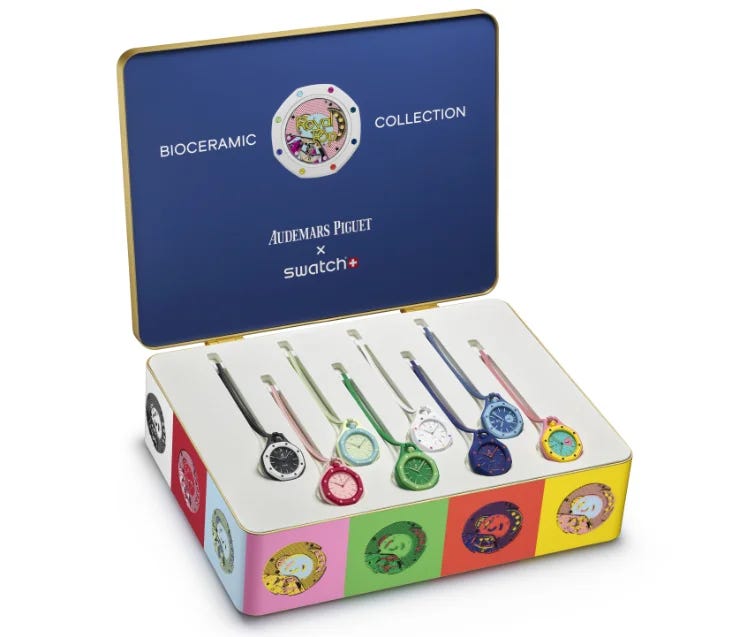
For Swatch Group, the logic behind the collaboration is relatively straightforward. The company sought to replicate the cultural phenomenon created by the 2022 Swatch x Omega MoonSwatch, which generated massive queues and widespread media coverage. It later followed with the Swatch x Blancpain Bioceramic Scuba Fifty Fathoms, a commercial success that didn’t achieve the same level of public attention.
For Audemars Piguet, the rationale appears more complex.
The company occupies the upper tier of Swiss watchmaking, and the Royal Oak remains one of the most recognizable luxury watches in the world. Former CEO François-Henri Bennahmias, who led the company from 2012 to 2023, strengthened the brand’s prestige through a series of initiatives aimed at collectors and enthusiasts. Among the most significant was the company’s decision to leave the SIHH trade fair in Geneva in 2019 (now known as Watches and Wonders) and focus on direct relationships with consumers.
Today, Audemars Piguet sells primarily through its own global boutique network, including approximately 25 AP Houses located in major cities. While anyone can access these special stores, they tend to operate more like private clubs, with lush furnishings, bars, and food, where clients can discuss watchmaking.
Most independent jewelers might have an espresso machine or a small bar in the back of a store for entertaining clients. These AP Houses are dedicated spaces that provide an all-immersive luxury experience. The AP House in New York’s Meatpacking District, for example, spans nearly 8,000 square feet, including an outdoor terrace. The strategy has been commercially successful, but critics have occasionally suggested that the brand has become somewhat insular and exclusive.
Resta, who became CEO in 2024, appears to be steering the company toward greater accessibility without abandoning its luxury positioning. Under her leadership, Audemars Piguet returned to Watches and Wonders this year, a move widely welcomed by the industry. The Swatch collaboration can be viewed as part of the same broader effort: reaching younger consumers, expanding awareness beyond established collectors, keeping the Royal Oak culturally relevant, and creating an accessible entry point into the brand’s universe.
A Successful Idea, A Flawed Execution
Whether the Royal Pop should ultimately be considered a success depends largely on how it’s being measured. From a marketing standpoint, the collaboration achieved remarkable visibility. It generated headlines around the world, drove unprecedented online engagement, and created intense demand for the product.
From an operational standpoint, however, by any standard, the launch was botched.
Swatch Group had already experienced similar crowd-control issues during the MoonSwatch release and should have been better prepared.
The recurring images of police interventions, shuttered stores, frustrated customers, and crowd-management failures created negative publicity that could have been avoided with better planning.
Because the launch was handled exclusively through Swatch stores, responsibility for execution rested primarily with Swatch Group. Yet, Audemars Piguet may ultimately face the greater reputational risk.
For many existing Royal Oak owners, the appeal of the brand lies in exclusivity, craftsmanship, and refinement. Seeing the Audemars Piguet name associated with scenes of disorder may reinforce concerns that the company is moving too far down-market in pursuit of broader visibility. At the same time, many younger consumers who waited in line for hours and left empty-handed may have come away with a less favorable impression of both brands.
The damage is unlikely to be lasting. The Royal Oak remains one of the most desirable watches in the world, and the Royal Pop succeeded in putting Audemars Piguet in front of millions of people who might otherwise never have engaged with the brand.
But if the goal was to make luxury feel more accessible, the events of May 16 suggest that execution matters as much as ambition.
