

[video: ECPAD.fr and imagesdefense.gouv.fr]
We can point to the end of the First World War as the period when American jazz entered France. Visualize a cold winter morning in 1918, when the 369th Infantry Regiment, an all-Black regiment, landed in Brest Harbor in Bretagne on the Atlantic Coast of France, later christened the Harlem Hellfighters for their combat bravery (earning them France’s Croix de Guerre). The regiment included a marching band led by a native of Mobile, Alabama, aptly named (for someone who would be a hit as part of a ragtime orchestra on the continent) Lt. James Reese Europe.
The Love Story begins with Hellfighters
This all-Black ragtime orchestra was already a legend in New York, having performed at Carnegie Hall in 1912. As soldiers, they gave their first concert on French soil in Brest only a few hours after arriving. Later, having served on the front for over six months within a Division of the 4th French Army, they played in Paris again in the summer, notably at the Théâtre des Champs-Élysées and in the Tuileries Garden. The Paris audience was enthusiastic – and far less shocked than the crowd that caused a near-riot when Igor Stravinsky’s Sacre du Printemps debuted in the same theater five years earlier!
Paris’s creative effervescence welcomed jazz into its cultural melting pot and became itself a jazz capital with Montmartre initially at its epicenter.
The term métissage – a cross-mix of ethnic groups – best defines the evolution and the history of jazz in France, reflecting the changes and events occurring when music, fashion, and art forms collide, mix, and mingle. Take the Roaring Twenties, when Cubism, Surrealism, Dada, and La Revue Nègre with Josephine Baker exerted a major cultural influence. This sometimes atonal and spontaneous musical backdrop can also be heard in the 20th century’s modern composers, such as Stravinsky, Aaron Copland, Maurice Ravel, or Darius Milhaud.
Paris’s creative effervescence welcomed jazz into its cultural melting pot and became itself a jazz capital with Montmartre initially at its epicenter. Here, famous Lost Generation expatriates Ernest Hemingway, F. Scott Fitzgerald, John Dos Passos, and composer Cole Porter, frequently met with Afro-American musicians, who, fleeing the racial segregation of America’s southern states, found in Paris a place where color wasn’t much of a problem. Jean Cocteau, Pablo Picasso, Guillaume Apollinaire, and Max Jacob could be seen mixing with the ever-so-slightly-racy demi-monde as well as high society; or crowding Pigalle’s cabarets and clubs: Chez Florence, Mitchell’s, La Plantation, or singer Ada Smith’s Bricktop. (Woody Allen’s unabashedly romanticized Midnight in Paris comes to mind…)
Cross-pollination… and Resistance
In the 1930s, with the early developments in the recording industry and radio broadcasts, jazz in France became even more popular. Following in the steps of the swing era, American big bands headed by Duke Ellington, Count Basie (who returned well into the 1950s to perform at the Olympia), Benny Goodman, Glenn Miller, etc. – and a handful of gifted French jazzmen including saxophonists André Ekyan and Alix Combelle – put together large orchestras and small groups. Hot jazz and swing took over in dance halls and clubs in and around the capital, often sharing the bill and jamming with visiting American soloists, thus spearheading the advent of French jazz through intercultural exchange and cross pollination.
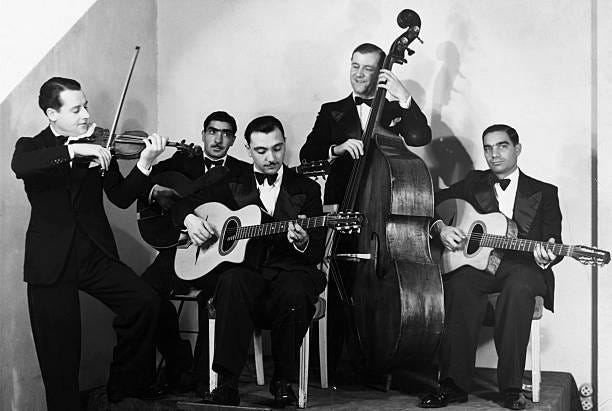
At the same time, a Belgian-born gypsy guitarist – and admirer of Louis Armstrong – was creating a buzz with his unusual technique and would rapidly become the first guitar personage in jazz history. His name: Django Reinhardt. Together with violinist Stéphane Grappelli, Joseph Reinhardt (Django’s kid brother) and Roger Chaput on rhythm guitars, and Louis Vola on bass, Django founded an all-string jazz ensemble: the Quintette du Hot Club de France – not surprisingly, an instant success. The jazz manouche was born!
In 1944, jazz was pulled toward the magnet of French intellectual life: to the Left Bank and Saint-Germain-des-Prés.
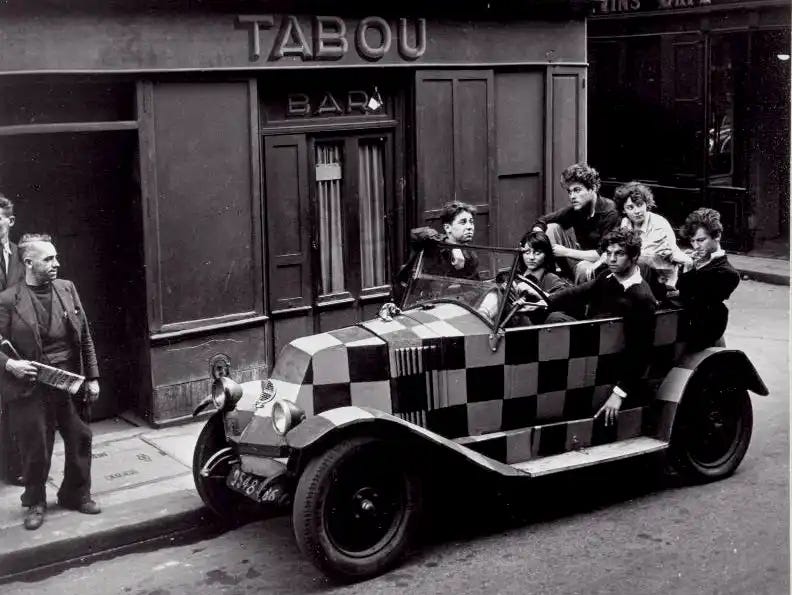
World War II pulled the plug on a lot of this music. During four years of occupation, when the Nazi regime outlawed jazz as degenerate music (Entartete Musik), enforced racial laws targeting Black people as well as Jews and other races, and banned American jazz records, jazz somehow survived. Nevertheless, a colorful tribe of young Parisians calling themselves the Zazous sported eccentric fashion and promoted a jazzy, defiant attitude as an act of resistance.
Jazz, Existentialism, and the Search for Meaning
With the Liberation in 1944, jazz was pulled toward the magnet of French intellectual life: to the Left Bank and Saint-Germain-des-Prés. The Café de Flore and Les Deux Magots, side-by-side in the heart of the sixth arrondissement, along Boulevard Saint-Germain, became the meeting place of the capital’s deep-thinkers, not least of whom was Jean-Paul Sartre. At night, self-proclaimed fellow existentialists – a mixed crowd of writers, poets, and musicians, under the tutelage of multi-talented inventor, writer, amateur musician, and premier social influencer, Boris Vian, gathered in caves (cellars), such as Le Tabou and Le Club Saint-Germain, dancing all night to live jazz intoxicated by post-war boundless freedom. Influenced by jazz and contemporary American literature, the Bobby Soxers succeeded the Zazous.
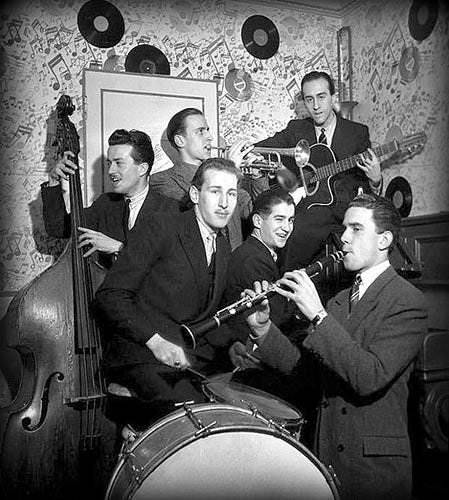
Those needing a guidebook to this new life could read Boris Vian’s 1950 Manuel de Saint-Germain-des-Prés – 300 pages of street guide-cum-user’s manual – a pataphysician’s catalog containing sardonic solutions to imaginary problems encountered in places and involving famous people, jazz discography, and whimsical anecdotes that were part of the living legend of Saint-Germain-des-Prés. It also featured real-world articles on cultural celebrities such as Sartre and Simone de Beauvoir and celebrity personalities like singer Juliette Gréco, whose liaison with Miles Davis made newspaper headlines in 1949.
In The Heat of Paris Nights
By the 1950s, the door to the Paris music scene was open, and in 1956, drummer Kenny Clarke, one of the bebop founders, entered, followed by trumpeter-arranger Quincy Jones and pianist Bud Powell. Musicians visiting Europe began making prolonged stopovers in Paris to enjoy the lifestyle and benefit from the city’s growing club attendance: saxophonists Dexter Gordon, Stan Getz, and Lee Konitz, and trumpeters Donald Byrd and Chet Baker. As the recording industry expanded, French jazz musicians, thanks to bebop, quickly assimilated new directions in modern jazz. This saw musicians such as pianists Martial Solal and René Urtreger, saxophonist Barney Wilen, drummer Daniel Humair, and bassist Pierre Michelot making a name for themselves among their US colleagues. European jazz was coming into its own.
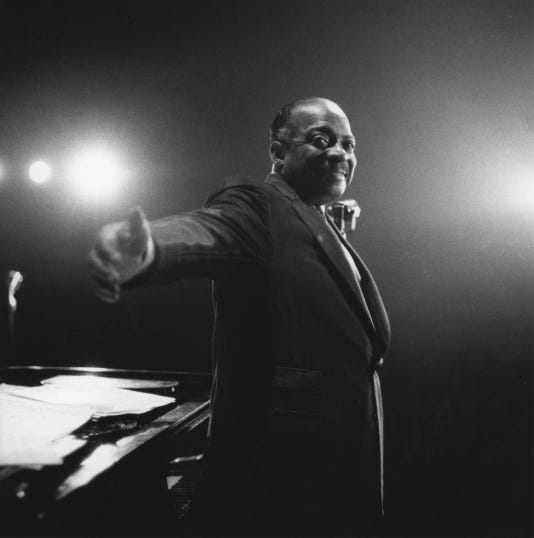
The Nouvelle Vague (New Wave) in the mid-1950s and 60s paired jazz and cinema and opened a new chapter in France’s love story with jazz. Film directors Louis Malle, Jean-Luc Godard, Roger Vadim, and Pierre Granier-Deferre – all jazz lovers themselves – commissioned established jazz musicians to write and/or perform in their film soundtracks. Ascenseur pour l’Échafaud (Louis Malle/Miles Davis), À Bout de Souffle (Jean-Luc Godard/Martial Solal), Les Liaisons Dangereuses 1960 (Roger Vadim/Art Blakey’s Jazz Messengers), Sait-on Jamais… (Roger Vadim/The Modern Jazz Quartet), and La Métamorphose des Cloportes (Pierre Granier-Deferre/Jimmy Smith) are still praised today by film buffs and jazz fans and are being discovered by a new generation.


The Golden Age
Jazz underscored the themes of emancipation, equality, and breaking the rules in the 1960s and 70s. Jazz giants such as Duke Ellington, Thelonious Monk, John Coltrane, Sonny Rollins, Stan Getz, Miles Davis, Charles Mingus, Ray Charles, and Chick Corea would regularly visit the French capital, giving historic one-night concerts or participating in the many jazz festivals blossoming all over France. These standard-bearers now belong to the history of music: their compositions and technique are studied in music schools and conservatories, their lives have become biographies in several languages, and their re-issued recordings on vinyl and CDs can still be heard on the radio and on the internet, inspiring the next generation of jazz musicians.
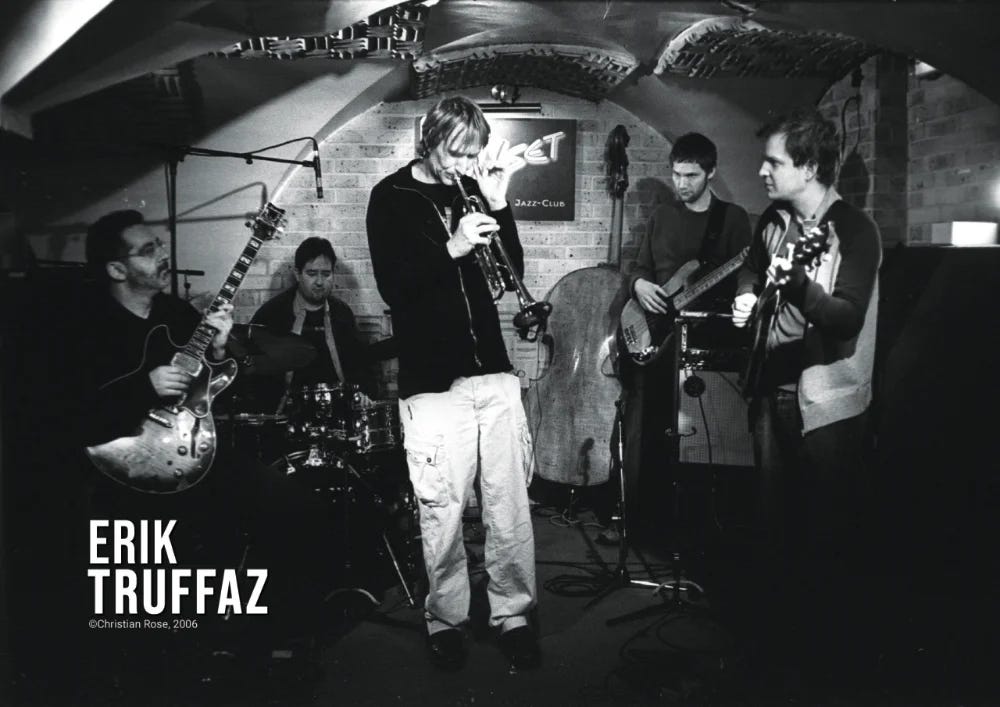
Thierry P’s Favorite Jazz Venues in Paris
New Morning, 7-9 Rue des Petites Écuries, Paris 75010
Sunset Sunside, 60 Rue des Lombards, Paris 75001
38Riv, 38 Rue de Rivoli, Paris 75004
Studio de l’Ermitage, 8 Rue de l’Ermitage, Paris 75020
Le Son de la Terre, 7 Quai de Montebello, Paris 75005
Caveau de la Huchette, 5 Rue de la Huchette, Paris 75005