

French Football Faces its Toughest Opponent: The Far Right
“Les Bleus” are the world’s most successful national soccer team of the last 30 years. But the home team isn’t universally loved in France.
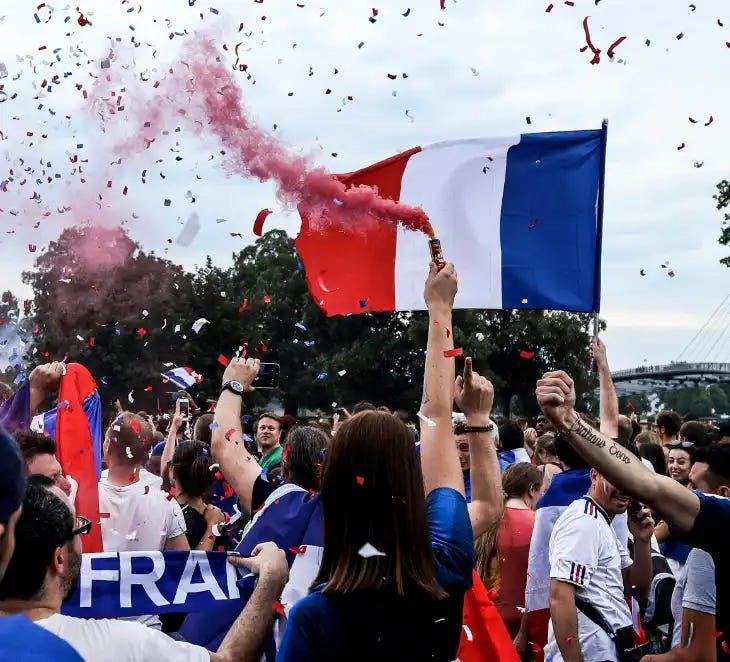
In France, soccer is more than just “football.” The French national team travels to the World Cup in North America this month with a good shot at winning the tournament for the third time since 1998. Meanwhile, in the country’s other great contest – next spring’s presidential elections – the far-right Rassemblement National party is currently favored to seize power for the first time, according to a recent poll.
The mostly Black team and the anti-immigrant party are longstanding enemies, talismans of opposing visions of France. Just before the World Cup, the team’s captain, Kylian Mbappé, raised in the Parisian suburbs by a Cameroonian father and an Algerian-origin mother, kicked off the latest skirmish in a 30-year battle, telling American Esquire: “I know what it means for my country when people like them get into power.”
“Immigrants” in the Lineup
The French team, les Bleus, has drawn from the country’s successive waves of immigration, French sociologist Professor Stéphane Beaud told the Anglo-American Press Association in May. The side that finished third in the 1958 World Cup included several players of Polish origin. The European champions of 1984 featured players of southern European descent, notably the captain, Michel Platini. By the 1990s, sons of African immigrants raised in the fast-growing suburbs of Paris began to join les Bleus.
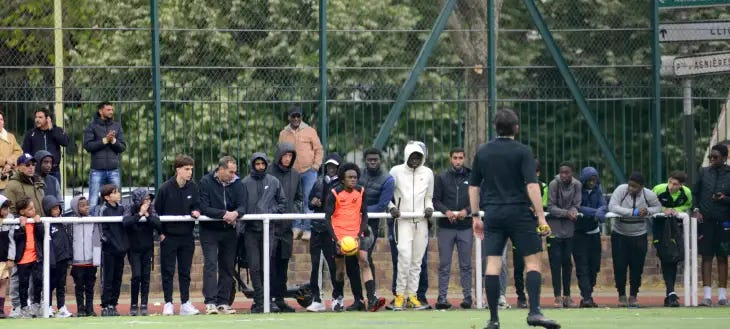
During the 1996 European Championship, the then far-right leader, Jean-Marie Le Pen, carped that it was “a little artificial to bring players from abroad and call them ‘the French team.’” In fact, almost every player was born in France, but in the traditional far-right view, nobody of immigrant origin could ever become truly French. Le Pen called the Bleus’ star, Zinédine Zidane, “an Algerian born in France.” His words echoed the far-right’s lineage: the prewar far right, too, often dismissed ethnic minorities with French citizenship as mere “français de papiers” – i.e., “French on paper.”
Already in 1996, the players pushed back. Didier Deschamps, who today is France’s coach, said that “once again” Le Pen had “talked nonsense.”
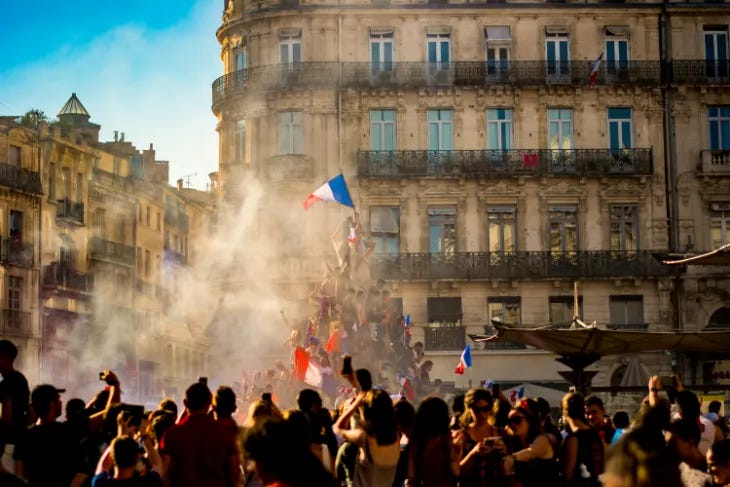
But Le Pen knew that many voters agreed with him. A mixed French team won the World Cup in 1998, prompting then president Jacques Chirac to laud “a tricolored and multicolored France,” as French headlines hailed the victorious “Black-blanc-beur” team. Yet, in 2000, a survey by France’s National Consultative Committee on Human Rights found that 36 per cent of respondents agreed there were “too many players of foreign origin in the French football team.”
Politics and the Playing Field
This century, Jean-Marie Le Pen and Zidane occasionally skirmished, with the latter repeatedly advising people not to vote for Le Pen’s Front National party. It might seem risky for a politician to take on the man who was named most popular person in France several times in the Journal du Dimanche newspaper’s twice-yearly poll.
However, the far right has always understood that most French soccer players start with three strikes against them in majority public opinion. Most are of immigrant origin; are emigrants who play for clubs outside France; and, in a country where suspicion of the rich is widespread, they are multimillionaires. This means that if they make the slightest slip on or off the field, they find themselves condemned.
Sitting it Out in 2010
The low point for les Bleus was the World Cup 2010, when the majority non-white team clashed with their white coach, Raymond Domenech, and went on strike mid-tournament. The image of the players sitting on the bus, refusing to train or to sweat the beloved blue shirt, went down in French collective memory as “The Bus of Shame.” After the team was knocked out in the first round, the then-president, Nicolas Sarkozy, instituted an inquiry.
Ever since, the team has striven for exemplarity on and off the field. Straight after beating Croatia in the World Cup final in Moscow in 2018, the players, in what looked like a planned PR gesture, literally wrapped themselves in French tricolor flags. Even in triumph, the predominantly non-white team had to seek the acceptance of the mostly white nation.
Mbappé became a world champion in 2018, aged just 19, and in 2022 scored three goals against Argentina in the World Cup final in Qatar, only for his team to lose on a penalty shootout. He once told me: “I have always felt French. Of course, I have origins that I don’t deny, and which are part of who I am. But I have made my whole life in France, and never at any point did anybody make me feel I wasn’t at home here.”
Yet, it was always more complicated than that. Even when France won, far-right leaders tended to compliment Deschamps, the beloved white coach, and other white players, while overlooking the rest of the team.
The conflict between team and party has hotted up now that the Rassemblement National has its best ever shot at power. In summer 2024, when the European Championship coincided with legislative elections in France, the French forward Marcus Thuram said: “We must fight so that the RN doesn’t pass.” He expressed “zero doubt” that “everyone in the team shares my vision.” Mbappé, who had long been cautious about making political statements, mostly backed him up, warning against “the extremes.”
Taking on Titans
But the far right remains happy to take on multimillionaire expat soccer players. Jordan Bardella, the 30-year-old who, like his near contemporary Mbappé, rose from the Parisian suburbs, and is now RN’s likely candidate for president, retorted that he was “a little embarrassed” to see multimillionaires “give lessons to people who can no longer make ends meet, who no longer feel safe, who do not have the chance to live in neighborhoods overprotected by security agents.” He was lumping together the non-white young men from the suburbs with the party’s other favorite bogeyman, the French elite.
Now Bardella is mocking Mbappé for the one ‘failure’ in an otherwise unblemished career: in 2024, the forward left Paris Saint-Germain (PSG) for the most successful European club in history, Real Madrid, only to watch Paris win club soccer’s biggest prize, the Champions League. “I know what happens when Kylian Mbappé leaves PSG: the club wins the Champions League!” Bardella crowed on social media.
Mbappé, still only 27, is aiming for his third straight World Cup final. Even if he wins, it might not be enough to beat the far right.
Editor’s Note: Paris St Germain captured the Champions League Final for the second year in a row on May 30, beating Arsenal 4-3 in a shoot-out win following a 1:1 draw at the match played in Budapest.

Mbappé has more talent and integrity in his petit doigt than loser Bardella who has accomplished nothing in his life other than spreading hate and lies, hitching his sorry ass to the Le Pen hate wagon. His self hatred for his own immigrant family origins is pathetic and dangerous. Allez Les Bleus, va te faire foutre Bardella/RN!
Sad 😔