

French Scream NIMBY! At New AI Data Centers
Citizens across France are taking up arms – or, at least, placards – to stop AI server farms from being built near their homes.

“Our house is on fire!” shouts an anti-data center protestor outside a local council meeting. “And Microsoft and Mulhouse metropolitan council are fanning the flames!”
The house-fire analogy is coincidental – the protest in question took place in June, weeks before France’s July heatwave produced the country’s worst-ever period of wildfires – but all the more ominous for it. Supporters of the “IA pas moyen !” (“No Way, AI!”) community collective in the Haut-Rhin region in eastern France reckon the spread of data center construction projects is equally out of control and needs, well, hosing back.
Similar grassroots protest groups are forming up and down the country, wherever a new data center construction project is announced or is already underway. They have been winning support from national lobbying organizations such as the Confédération Paysanne (Countryside Confederation) as well as a fairly broad range of political groups from the Écologistes to the Socialist Party.
Data centers are not popular in France, it seems. But is it all just a case of “Nimby-ism” – Not In My Back Yard – by which people are happy to make use of innovative digital technology on their doorstep as long as the physical infrastructure is built somewhere else?
Is it Too Late to Stop?
It’s not as if large data-handling locations are anything new. Warehouse-like data houses have been proliferating hand-in-hand with the development of cloud computing. These virtual platforms need somewhere physical to exist: computer chips, memory, cables, and so on, all secured with the kind of in-real-life protection you might expect of a gold reserve. There are more than 350 data centers already in France, with some 200 in the Île-de-France region alone.
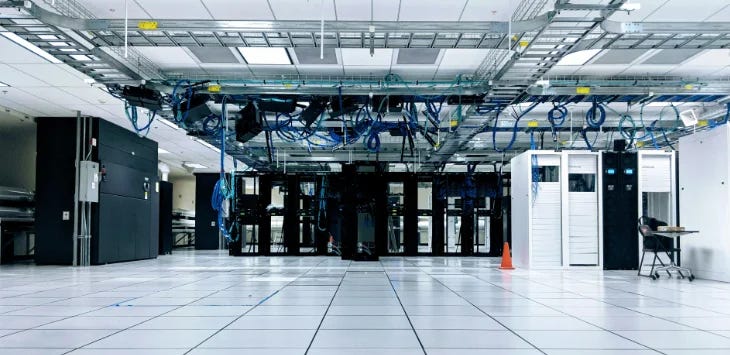
The real game changer is Artificial Intelligence. AI demands not just unimaginably vast quantities of data but also far greater processing power than mere cloud computing. AI platforms need dedicated data centers of their own: bigger, better, and exponentially more resource-intensive.
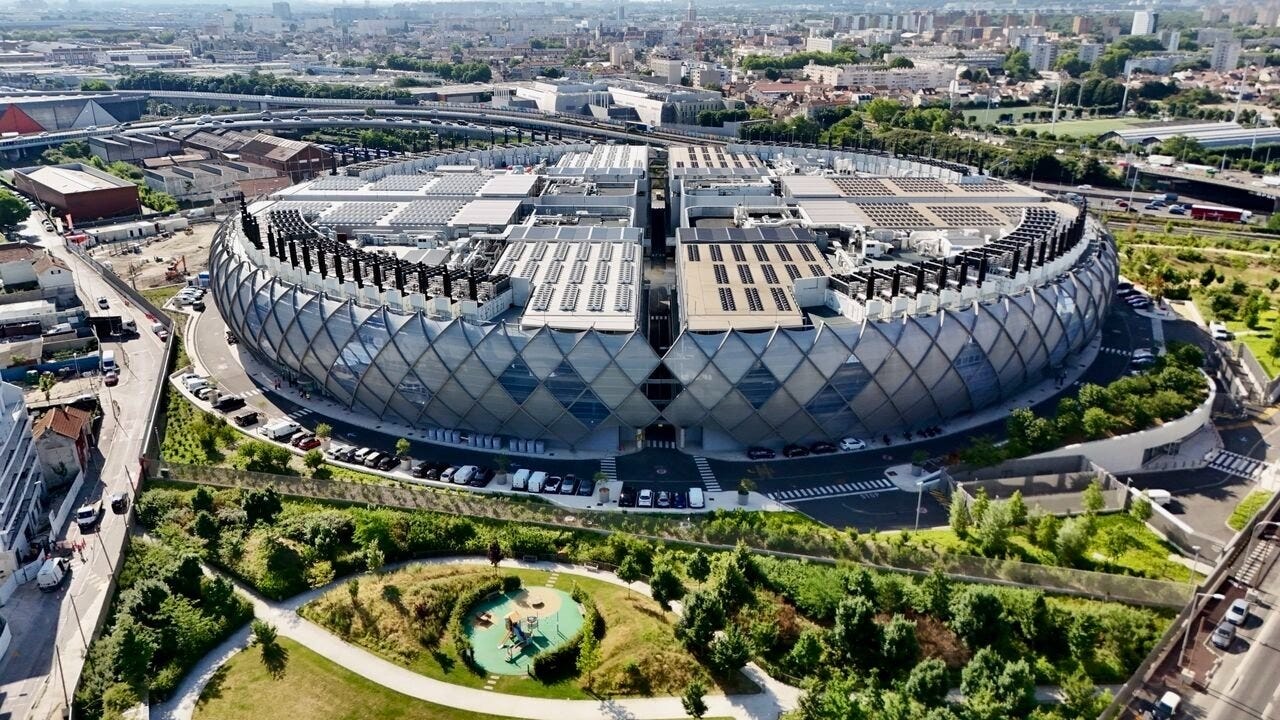
France’s biggest live data center – currently, at least – is Paris Digital Park situated in La Courneuve to the east of the impoverished Saint-Denis area of greater Paris. Occupying 40,000 square meters over four stories, it houses some 630,000 servers and 5,000km of cabling. It looks part-fortress, part-spaceship.
To maintain 24-hour operation, the site gobbles up 130 megawatts (MW) of electricity. This is about the same consumption as the entire southern city of Perpignan. To prevent the servers from overheating, its cooling system gulps through 50 million liters of water each year; enough to fill 20 Olympic-sized swimming pools.
And yet, despite the threat of another 300-plus new data centers to be constructed across the country over the next few years, the pushback remains highly localized rather than national. Local people feel that AI data centers have crept up on them unannounced and accuse government decision-makers of forcing projects through behind their backs.
Their complaints are starting to be heard. On July 10th, the Grenoble administrative court suspended the building permit for a new 40-80MW data center in Alixan, a village of fewer than 3,000 inhabitants, citing the risk “of causing harmful effects on the environment.” Apparently, no environmental impact study had been carried out before Alixan’s mayor granted the building permit. A spokesperson for the local campaign group called the application “clearly illegal.”
Similar grumblings were expressed when an even bigger 1.4 gigawatt (GW) “Campus IA” project was recently given the go-ahead in Fouju, a hamlet of just 700 people, within the Melun district of the Seine-et-Marne department east of Paris. In the center of the country, the possibility of a major project in Châteauroux was warmly received by its mayor, who then had to backtrack when locals launched a petition demanding a moratorium on the construction of large data centers in the area.
Macron: “Plug, Baby, Plug”
Such objections are a far cry from the generally positive reception just over 18 months ago when President Macron pitched France as an “Eldorado” for AI business. Speaking in English at the AI Action Summit in Paris in February 2025, he mocked his American counterpart’s “Drill, baby, drill” slogan by proposing a French alternative: “Plug, baby, plug.”
Investors took the hint: France has an extensive network of nuclear power stations, so connecting newly built data centers to a reliable and affordable power grid is virtually guaranteed. Detractors claim that gifting these companies cheap electricity raises the risk of shortages or even power cuts for everyone else in the locality, not to mention rising prices resulting from competing demand. Environmentalists decry such a waste of energy spent on (in their view, largely unnecessary) AI.
The use of water as a coolant is more contentious, for both sides. Local protestors express fears that data centers will dry up their rivers and squeeze what remains of the precarious water table in drought years. Data center builders point out that their cooling systems rely on clean water only. Environmentalists decry such a waste of clean water.
There is more than electricity and water at stake, say protestors. Data centers are supposed to be built on brown-field sites but that is no guarantee that this happens. The project at Mulhouse, for example, will be spread across 40 hectares (almost 100 acres) of agricultural land, a quarter of which is dedicated to organic farming.
AI Companies Fight Back – Nicely
Investors in AI infrastructure building are responding to the darkening mood among municipal voters by trying to pre-empt objections, to counter misinformation, and to foster good faith by at least engaging with local inhabitants.
Google itself invited locals to a meeting at its Waltham Cross data center in Hertfordshire, in the UK, at the end of July. Residents complained about the lighting being on all night; Google promised to address this. Campaigners complained about the water usage; Google explained that it uses a closed-loop system that condenses and re-uses the water rather than just letting it evaporate.
If such solutions can already be found, say campaigners, why don’t all data centers apply them? The same goes for energy consumption: even Elon Musk reckons that server farms should be covered with solar panels so that they can at least generate a little bit of their own electricity. Then again, he also thinks they should be floating in high orbit – who knows, possibly communicating with Earth via laser.
In the meantime, campaigners have been disappointed by the National Assembly’s six-month inquiry into the country’s IT infrastructure. Delivered at the beginning of July, the report concentrates on the economic benefit of achieving digital sovereignty, which would include the building of French-owned and French-controlled data centers. However, it admits that, due to time constraints, it did not examine the environmental impacts of data centers.
The hope is that France’s urgency to achieve digital independence from the US tech giants will not brush aside the environmental concerns of its own citizens. But with opposition to data center projects on the rise, it’s clear that local people are not waiting around to find out.
AI Infrastructure Builders are Told: Do No Harm
France is far from being the only country witnessing local community and council pushback against data centers in recent months.
In July, New York Governor Kathy Hochul signed an order to freeze new data center construction until applicants can prove they won’t indirectly push up local energy prices.
A referendum held in June in Monterey Park in Los Angeles halted the construction of new data centers in the area, permanently.
Sarasota County Commission in Florida voted unanimously to suspend data center construction for a year.
In Australia, Prime Minister Anthony Albanese outlined, as part of the nation’s AI policy, how AI companies would in future be expected to fund electricity generation projects, including the costs of bolstering energy grids to support new data centers.
Server farms in Ireland currently consume 23 percent of the country’s electricity. New data centers connecting to Ireland’s electricity grid are now expected to install their own on-site generators or battery systems and to be prepared to feed unused electricity back into the grid.
