

I discovered a little-known Paris secret recently: its auction houses. I wandered into a couple of them – Sotheby’s Paris and the Hôtel Drouot – and couldn’t believe what I found: Roman statuary, cultured pearls, busts of Napoléon, avant-garde art, vintage Prada, mid-century furniture, and on and on.
Some of it was elegant, some of it tacky. None of it was dull.
It Started with Henri II
Auction houses in France have a quirky history. For centuries, only French ones were allowed to operate in that country, thanks to a royal edict passed by Henri II in 1556. Besides infuriating foreign competitors, this had a negative impact on both the French economy and patrimony, as some objets d’art were sold abroad where they tended to fetch higher prices.
This monopoly remained in force until 1998, when it succumbed to pressure from the European Union and the firms Sotheby’s, Phillips, and Christie’s, the latter of which is currently owned by Groupe Artémis, the holding company of François Pinault. Three years later, in 2001, Sotheby’s held its first public auction in France.
I returned to the auctions for a second time recently to see what was what… and to find out who would shop there. First stop: Sotheby’s, where I focused on jewelry – that most frivolous of indulgences.
There was so much to gape at! The waiting room and public spaces were glossy, minimal, shiny, and chic.
I’d forgotten how thrilling a live auction can be, from the moment a person fixes upon something they just have to own, to the actual sale itself, which typically takes place a day or two later.
For me, the experience brought a dose of nostalgia along with it. My father was an independent art dealer, based in London, and I vividly recall the chilly formality of the first of many auctions he brought me to, that one held at Phillips Son & Neale (now called Phillips) in New Bond Street. Needless to say, I was the only teenager in attendance.
The audience there was almost exclusively male. Some, I kid you not, arrived wearing bowler hats, which they placed on their laps for the duration of the sale. The auctioneer, standing at a podium before us, called out in a rapid, clipped patois. At one point, my father nodded curtly, the man at the head of the room took notice, and yet another painting, likely destined to be resold, joined our family.
Under the Gavel at Sotheby’s
Decades later, in the auction rooms of Sotheby’s Paris, the atmosphere is crisp. Guards stand in the background as photos of the jewels, ranging from a diamond-encrusted brooch of purple sapphires to a pearl necklace with a star motif, flash onto screens on either side of the room. Bids are listed, too, most clicking higher and higher.
To my surprise, I am one of only five people actually seated in the auction room; a few other potential bidders hover at its periphery. If the number of real humans is vanishingly small, the number of virtual ones seems outsized. Bids, pouring in via telephone or the internet, are tallied by Sotheby’s employees seated at long tables to the side of the room.
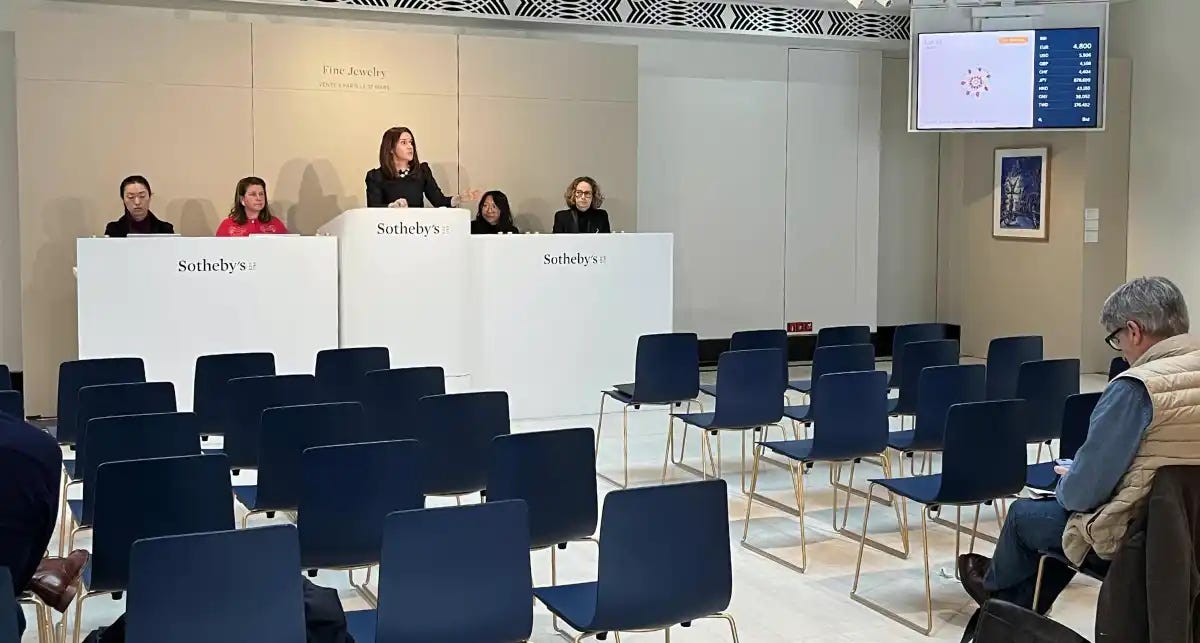
The auctioneer (commissaire-priseuse), likely in her early forties, wears a stunning diamond necklace that I suspect isn’t hers. She moves with great confidence. “It’s against you; it’s actually in my book,” she says, courteously advising one man that his is no longer the upper bid. She brings down her gavel decisively, after calling out “No regrets” or “Quelques minutes de réflexion,” to give bidders time to think it over before the item they covet – a ring set with a foiled-back antique rose-cut diamond, perhaps? – is decisively theirs. (That bauble sells for €13,000.) There’s no backing out in auctions.
The elegance of Sotheby’s is inspiring. It isn’t just the look of the place but how seamlessly it all moves. Even the empty minimalism of the auction seems chic.
Democratic Drouot
A day or so later, I make my way to the 174-year-old Hôtel Drouot – the very epicenter of the Paris auction scene. It’s impossible not to find the place. It’s in my face, in one form or another, from the moment I emerge from the Richelieu-Drouot metro station. There’s a Café Drouot across the way and two storefront art appraisers nearby, including one affiliated with the auction house itself.
The current Drouot building, designed by architects Jean-Jacques Fernier and André Biro, dates to 1980. It replaced the original, 19th-century structure, even recycling some of its metal components. Today, some 70 independent auction houses, selling more or less everything, operate there under the Drouot name.
My first impression of its viewing rooms is how everyone seems to be on the hunt – crossing the room taking notes, zeroing in on what they want to buy. There is a competitive feeling to it all, some sharp elbows among the connoisseurs.
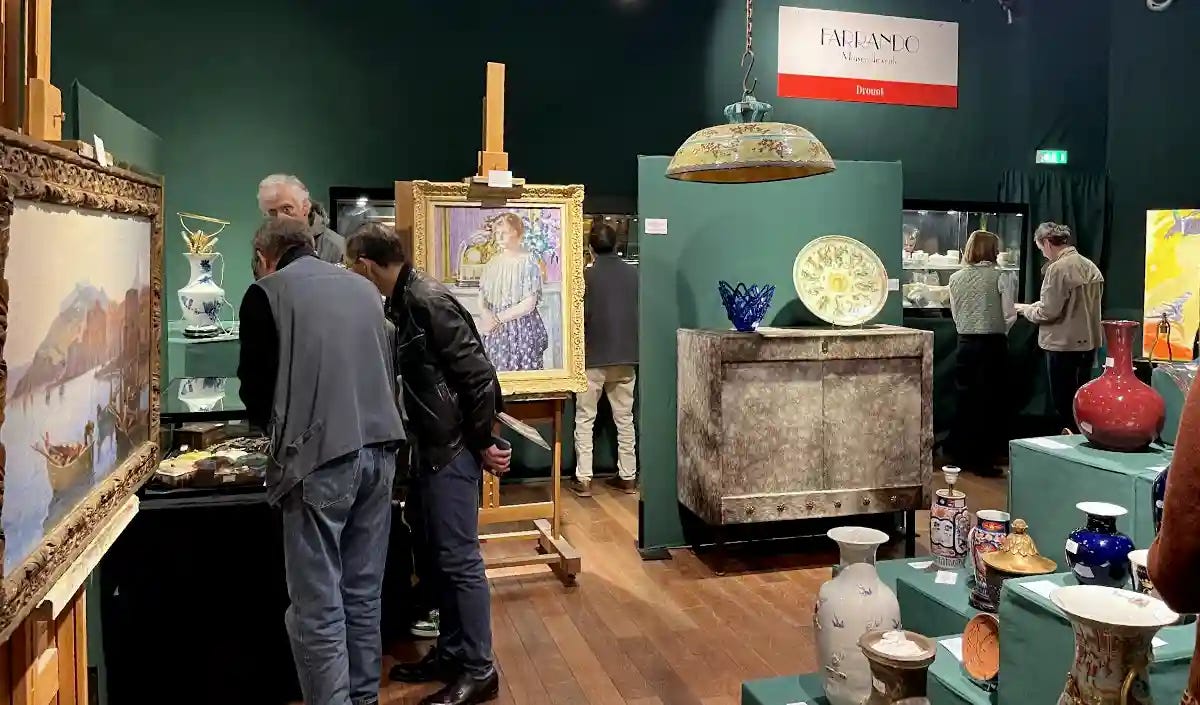
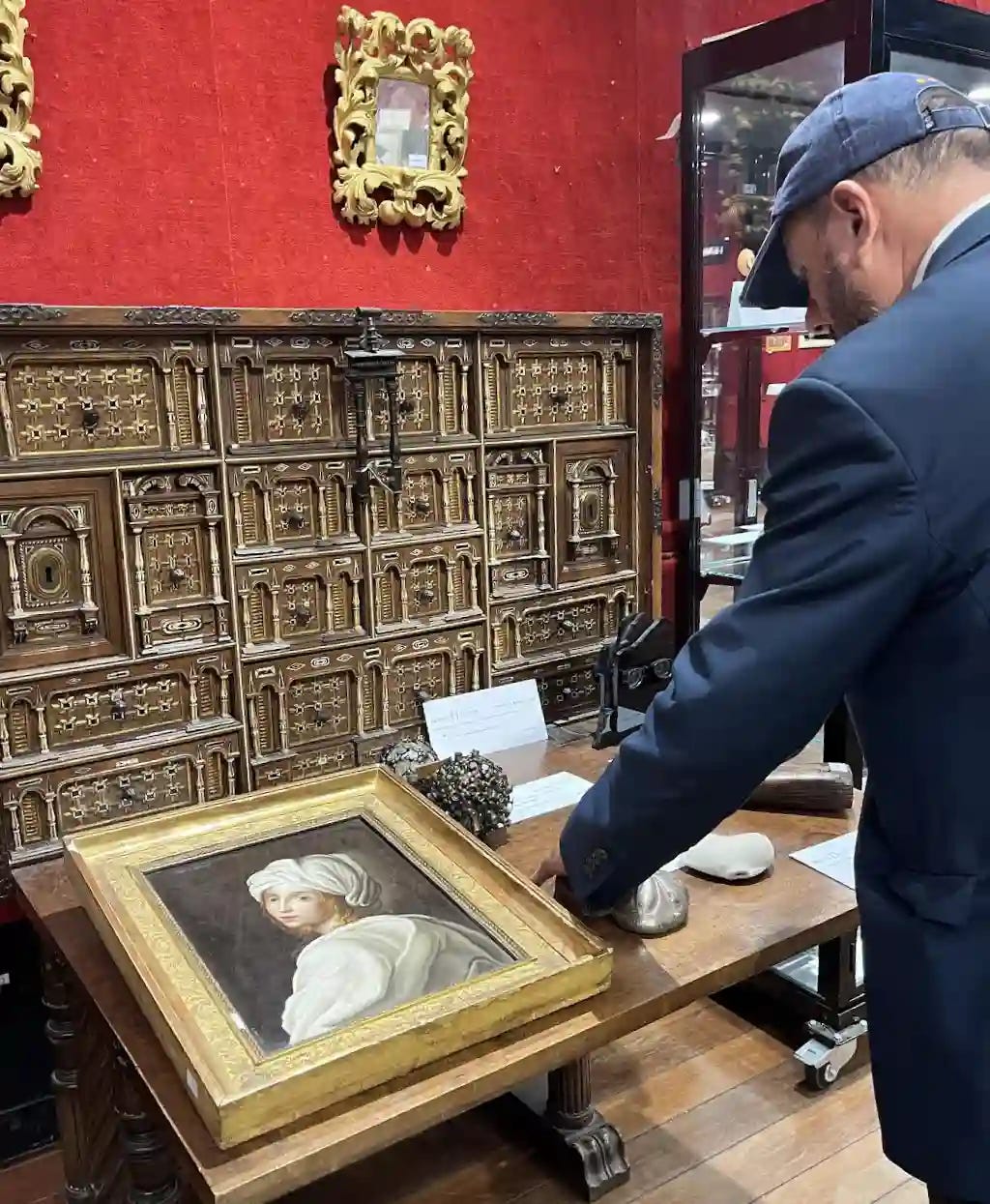
Compared with Sotheby’s, there’s an appealingly non-elite, everyman nature to Drouot. It’s almost Balzacian, with people from all walks of life wandering its halls. There is less poetry in the auctioneering, too: no one on the Drouot staff has put on a diamond necklace for the occasion.

Still, both auction houses play by the same script. Drouot’s young commissaire-priseur speaks of one Marcial Berro coral and crystal necklace as being part of an “exceptional collection” by that designer. And he calls out a decisive “Dernière chance,” before banging down his gavel.
Why I am Sold
Visiting both sales was heartening to me. The atmosphere was welcoming, even casual. There wasn’t a bowler hat in sight and, presumably, even a young teenager would be welcome.
For those who’ve felt intimidated by the auction scene – don’t be. It’s uniquely entertaining and attendance is free. Go there for the fun of it, and even to shop.
Sotheby’s Paris, 83 Rue du Faubourg Saint-Honoré, 75008 Paris. Tel: +33 (0)1 53 05 53 05
L’Hôtel Drouot, 9 Rue Drouot, 75009 Paris. Tel: +33 (0)1 48 00 20 00
Editor’s Note: There’s also the Paris pawn shop, Crédit Municipal in the Marais, founded in 1637, which holds regular auctions in person and online.
