

It’s Nesting Season in Paris: Prepare for Chaos
PARIS SAUVAGE In the spring, Paris is full of birds competing for nooks and crannies to build nests and raise their chicks. Some end up underfoot on the ground and need help. Here’s how to do it…

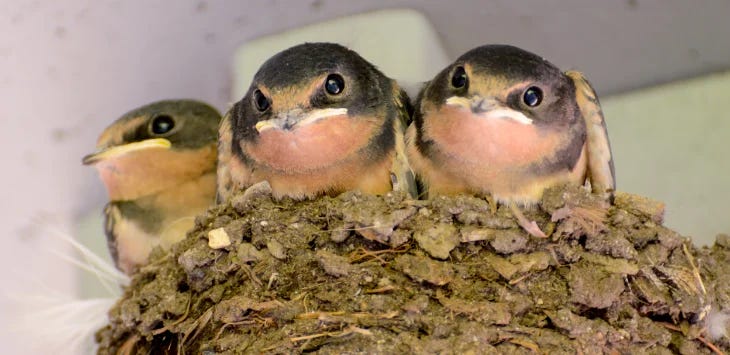
Nesting season kicks off in April and May, just about the same time that summer tourists begin flooding the city, and everyone is looking for a place to “nest.”
Two of the most noticeable birds nesting in Paris are Common Swifts and Eurasian Blackbirds, but they are not alone. Look atop streetlights for Eurasian Magpie nests; old buildings are a favorite of Eurasian Kestrels; and parks provide cozy spots for dozens of bird species, including European Robins, Mallards, and their fluffy ducklings.
Wing and a Prayer
Screaming flocks of Common Swifts (known in France as Martinet Noir) announce their arrival in Paris, blasting their way through the sky in circles, hawking insects. They have a packed agenda after a long migration: finding a mate, building a nest, and raising a family in just 100 days before commencing their long-distance return to sub-Saharan Africa in August.
Common Swifts nest in noisy, active colonies, tucked under the eaves of older buildings, constructing mud nests that hold up to four eggs. Their chicks, weighing just three grams at hatching, may stay nest-bound for eight weeks before launching into a life spent almost entirely on the wing.
These nests can get hot and crowded. Chicks may tumble or jump out and may still be alive on the ground. Alarming as the scene appears, many of these tiny chicks can be saved, and we’ll get on to how to do that in a moment.
Flocking to Paris Parks
The dried-grass nests of Eurasian Blackbirds (known in France as Merle Noir) are found in parks around the city anywhere from close to the ground to high in a tree. Recognizable by their melodious call, they are identified on the Louvre’s website as a bird of the Tuileries Garden.
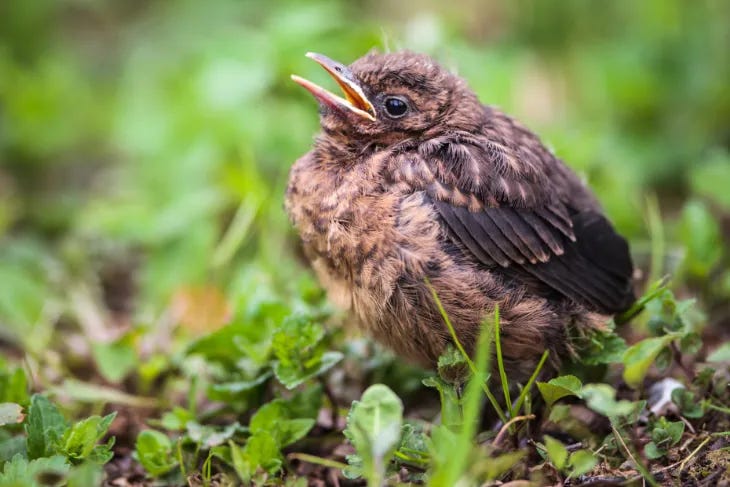
Unlike swifts, blackbird chicks leave the nest before they can fly. These fledglings are recognizable by their short tails and fluffy feathers. For more than a week, they remain on the ground, dependent upon their parents for food and guidance until they can fly – relying on stillness and natural camouflage to help them avoid detection.
Some people in cities like Paris may not notice little chicks in distress: featherless nestlings, having fallen from the nest, lying flat on the sidewalk; or rumpled fledglings, wandering around alone like a lost toddler. Those who do notice may mistakenly assume that all grounded fledglings are abandoned and unknowingly cart them off, instead of leaving them in place where their parents can retrieve them.
Well-meant human actions such as these can cause irreparable harm or even death. Knowing what to do and how to do it is essential to helping baby birds.
Dos and Don’ts
Any chick that appears injured, listless, dehydrated, or dazed, needs immediate care. Otherwise, the chick’s physical maturity will determine the appropriate human intervention.
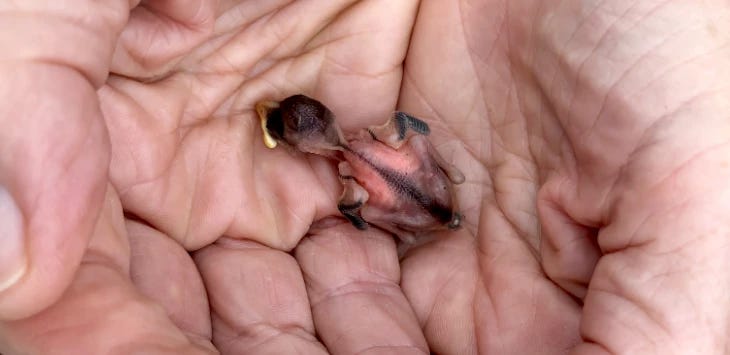
If the chick is featherless or has down only, this is a nestling and needs to be in the nest. If the nest is in sight and intact, carefully pick up the chick and put it back in.
If the parents fail to return, or the nest is unreachable, the chick – particularly one without feathers – will lose heat quickly and may die. In this case, place the chick in a paper bag or small box with air holes and immediately find help.
If the chick is feathered but uninjured and appears alert and healthy, this is a fledgling and should be left alone unless there is immediate danger. The chances are very high that this fledgling is in training – with parents likely hiding close by waiting for the chance to return to their youngster. No one will take better care of a fledgling than its parents who are temporarily caring for them on the ground!
If any bird is injured, regardless of its age, it should be taken to a licensed rescue center immediately. In any event, avoid the urge to feed or water any chick – it’s best to leave that to the pros.
Where to Go:
A network of specialty rescue organizations across France assist injured wildlife.
Resources in Paris:
The Faune Alfort Association, located at the Maisons-Alfort Veterinary School, is the primary bird and wildlife rehabilitator for the Paris region.
In 2025, Faune Alfort received over 10,400 birds and animals. Their mission is to rescue, rehabilitate, and release all wild animals to the wild. Consult Faune Alfort’s advice on safely transporting birds and mammals for care.
Their animal drop-off center, at 7 Avenue du Général de Gaulle, 94700 Maisons-Alfort (Metro Line 8, ‘Ecole Vétérinaire’ stop; RER D), is open seven days a week, from 10am to 6pm, without an appointment. Animal care is free of charge.
Editor’s Note: And check out this exhibition at the Musée du Quai Branly, Feathers of Paradise, running until November 8, 2026.

Deborah Rivel is an award-winning wildlife filmmaker; co-author of bird-finding book Birdwatching in New York City and on Long Island and owner of streaming nature sounds WildTones.com. She serves on the Audubon CT/NY and Friends of BirdLife International boards, and on the BirdLife Advisory Group, and founded a volunteer group which monitors beach-nesting birds. Deb travels extensively photographing birds and wildlife, and works to engage and inspire people to experience and protect nature.
 | A guest post by
|
Wow! The photos are so great to see alongside the text. As always,in awe of their migration journeys.