

Mastering the Mysterious Art of French Table Manners
LA FLÂNEUSE While the French are rightly famous for the quality of their cuisine, there’s a whole host of unspoken rules on the etiquette around consuming it...

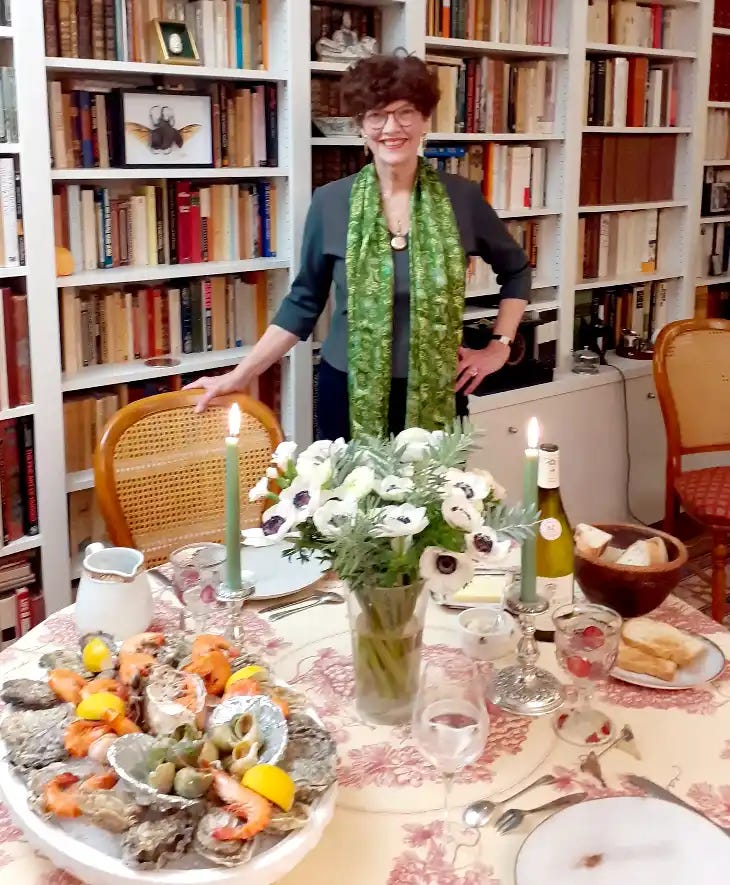
What is a flâneuse?
According to the Cambridge Dictionary, a flâneuse (or flâneur if a man) is someone who “walks around not doing anything in particular but watching people and society.”
Holiday gatherings – what is the first word that springs to mind? For me, it’s… “la bouffe.”
La bouffe refers to eating or a meal, but it’s best avoided until your French is so good, you know exactly when and where it can be used.
I write this from experience. Shortly after marrying my French husband, I complimented my mother-in-law on a particularly delicious repast with the following phrase: “On a bien bouffé. C’était délicieux.”
The last sentence was fine, but the first one almost put her into a faint. When she recovered, she gently explained (beginning with her affectionate “ah, ma petite fille…”) that bouffe is more akin to grub or chow. If you want to thank your host for a wonderful meal, she said, replace the inelegant bouffe with “On a bien diné.” Or, better still, “Nous avons passé une soirée délicieuse” (or “formidable” or “très agréable”), which covers it all.
Of course, people say “bouffe” all the time. My mother-in-law was simply trying to keep me from making a fool of myself by using the word in the wrong phrase and the wrong context.
As time went by, my mother-in-law taught me innumerable things, not only about the subtleties of French vocabulary and usage but also about the making and serving of five-course meals and what to do and how to act if and when invited to dinner in a French home.
Navigating the French Kitchen
I could have landed in a French family where nobody much cared about food (does that exist? Yes…) or where a cook prepared the meals (wouldn’t that be nice…).
Mais non.
For my husband’s grandmother, mother, aunts, and sister, cooking is second nature. And with nary a recipe book in sight.
I will never forget the first time I watched my chic Parisian sister-in-law in the kitchen of the family country house. Dressed in a silk outfit and high heels, she scurried around tasting what was cooking (I think it was a sauté de veau), prepared a vinaigrette and made a salad, laid out a sumptuous cheese plate, and checked on the pie she had made that was cooking in the oven. The kicker is… that she didn’t wear an apron! To this day, she never wears an apron! And never gets a spot!
When you’re up against a kitchen in which all the women are chatting and cooking family specialties you know nothing about – and on top of that you are not wearing an apron – there are only two solutions: give up or get on board.
I got on board.
The Pomme de Terre Affair
Rather than feel sorry for myself (you know, I’m just an American klutz who knows nothing, boo hoo…), I began to hang out in the kitchen and watch the ladies doing this and that. Occasionally, I would be assigned to cut vegetables or some such subaltern task. But even then… As my mother-in-law watched me peel potatoes one day, she observed: “I see that you’ve never lived through a war.” (No, indeed I had not, but she had and never forgot the deprivation).
Speaking of war, that remark could easily have sparked off a mother-in-law/daughter-in-law guerre, but I decided not to go there. (Wise move: I now know how to peel a potato and leave some potato).
And, oh, the things I learned in that kitchen. As I wrote in French Toast, the cleaning of vegetables was an obsession. One had to cut the pithy green inside the carrots. As for tomatoes: my mother-in-law peeled them and then gently squeezed out the seeds. (I tried – it looked like an axe murder).
My husband inherited her manie, so guess who prepares all the lettuce salads in our home? He inspects the salad leaf by leaf, making sure that no insects or dirt are present. He washes each leaf one by one, then rips them to edible size. And, bless his artistic French heart, he would never let a boiled potato out of the kitchen unless it had a bit of parsley sprinkled on it. As for eating potatoes with their skins, no way. “Only hogs eat potato skins,” he declares.
I could go on and on (and did in French Toast) but suffice it to say that all the time watching my in-laws in the kitchen paid off. It took a few years to do it easily, but the day arrived when I could put together and serve a decent five-course French meal!
Rules of Engagement
Concurrently – and here’s where you, dear reader, come in – I learned many valuable French table rules to apply when I was the guest, not the host.
There were lots of them. Casual gatherings with old friends weren’t a problem. The social French dinner party, though, can be a real killer for a novice. I know from experience: I attended many of them throughout my husband’s career. But the rules apply at home as well, and to make sure that things haven’t changed radically since our day, I ran the following list past my son and his wife and their teenagers. I thought they might make fun of me and say that all that was in the Dinosaur Days. Instead, they nodded their heads in agreement on every single point.
So, here are a few tips on what not to do at a French dinner table.
DON’T
Show up on time. If the host says 8pm and you are there at 8pm, walk around the block. 8:15pm is perfect. Why? The hour given is an indication, but no French (or Parisian) host actually expects people on time.
Expect to visit the apartment or house. Unless invited to do so, forget it. The French, like the English, believe that a man’s house is his castle. And they want people, including their guests, to penetrate only so far into their intimacy.
Bring chrysanthemums or carnations. The former is for funerals; the latter supposedly bring bad luck.
Offer a bottle of wine. Why? Your hosts have gone to a lot of trouble to make a meal in which the wine and the food are harmonious. If you arrive with a bottle for them to open and serve, you’re throwing off their plans. Better to bring a bottle of whiskey or a digestif like Cointreau.
Get up to help in the kitchen (unless you offer to help and the host accepts). Why? The host or hostess knows his or her role, which is to direct the show. Your role as guest is to stay at the table and be sociable. Plus, most French kitchens are tiny. Not to mention the possibility of boo-boos. On one occasion, early on, I trekked back to the kitchen of a French friend and dumped what I thought was a bowl of water into the sink. Turns out it was the syrup for her fruit salad. She was not happy. To keep out of trouble, remain seated!
Get up from the table (to go to the bathroom, or other) unless it’s an emergency. Très impoli. (And this was confirmed by my teenage granddaughters who wouldn’t even conceive of doing so.)
Pick up the wine bottle and serve yourself. Très vulgaire. The host is supposed to serve the guests. And if it doesn’t happen? You kind of swish the remaining wine in your glass around and hope they will look your way.
Announce your allergies. If you have a serious, life-threatening allergy, you must of course warn your host when invited – not when you are already there.
Talk about money. Films, books, and concerts, current events, and even sex, religion, and politics are okay as long as you keep it light.
Say “Bon appétit.” The worst. My husband cringes when I do (or did) this. He says it’s démodé (old-fashioned) or redneck. Ouch. So, what are you supposed to say? Nothing!
DO
In spite of all of the above, relax! Foreigners get a pass (until they have lived in France for so long that they should know better).
Bon appétit !
