


Arriving with my children in the United Arab Emirates, I am eagerly anticipating our holiday. I have a little itinerary all mapped out in my head. First, the famous Sheikh Zayed Mosque, then the Louvre, and the Abrahamic Family House. A friend based in Dubai had told me it was an extraordinary place. The itinerary is ambitious, but I hope to wrap it up in style with a visit to the Sorbonne University Abu Dhabi.
During my studies in the humanities, I attended the Sorbonne on Rue Victor Cousin in Paris. So, I’m curious to discover the Emirati extension of this historic institution. Founded in 1257, the university is a relic of the French Middle Ages, so its expansion to the Middle East – a symbol of opulence and modernity – has always struck me as anachronistic. The United Arab Emirates seems too “new” for a university rooted in the 13th century.
From Holiday to Hostilities
We drive to Abu Dhabi, in a relative’s car, around noon on February 28. As a journalist, I’m usually glued to the news, checking the AFP dispatches. Today, there is, literally, a bombshell: Iran, attacked by coordinated American and Israeli strikes early this morning, has just retaliated against Qatar, Kuwait, Bahrain, and the Emirates – neighboring countries that are home to US bases.
I immediately think of the airspace. Will it close? Should we return to Dubai? My children are taking the events lightly. My sister, who accompanies us, is too. “You know how it is here,” she says mockingly. “In 48 hours, it’ll be over.”
Fear grips me briefly as I enter the mall next to the mosque to buy a headscarf for myself and a qamis for my son. Inside, the mall is full of tourists from all over the world, strolling through the aisles. No panic shows on their faces. Then, seconds later, everything changes.
Missile Alert
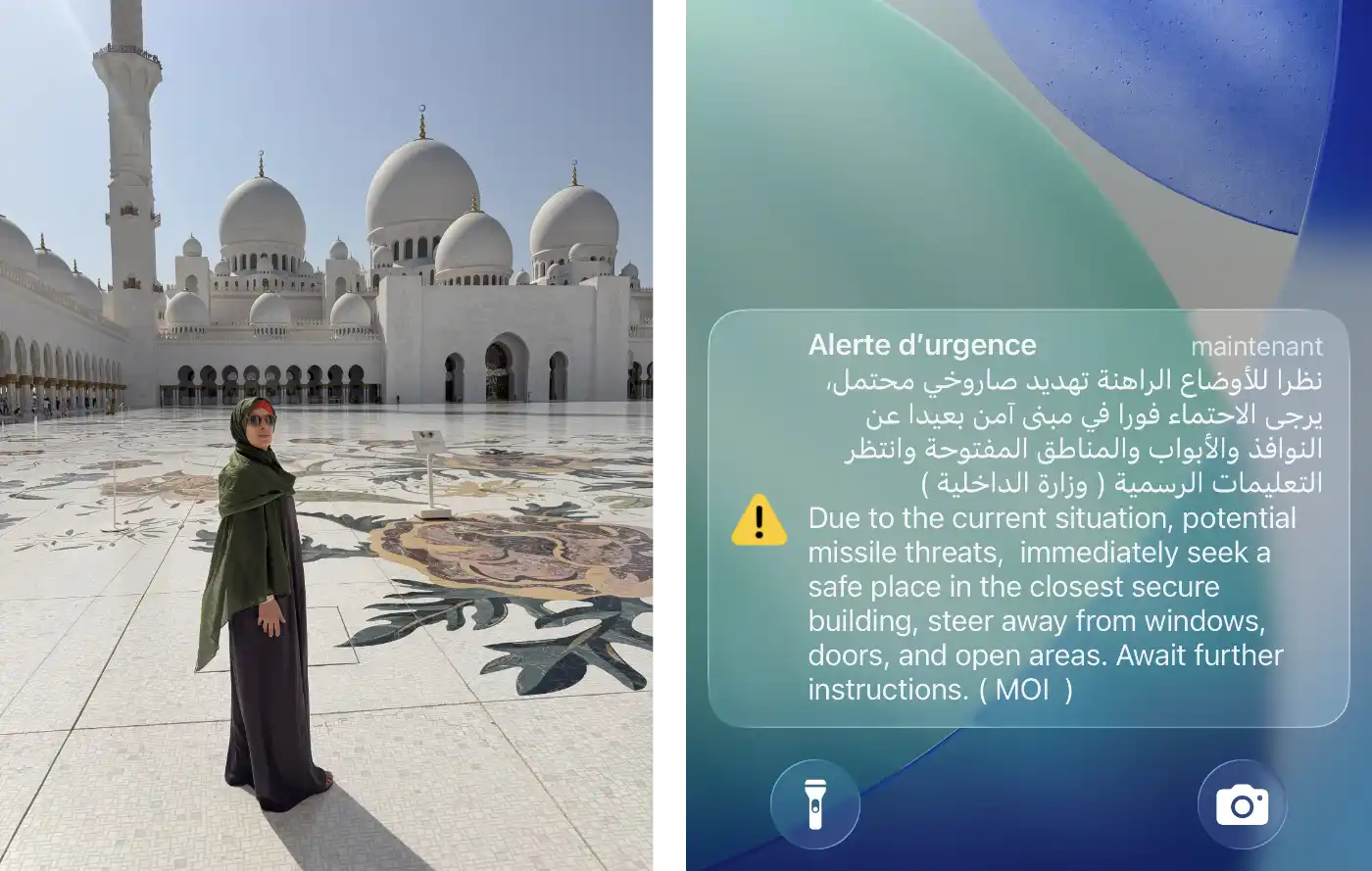
A missile alert sounds on cell phones. A message pops up: “Due to the current situation, potential missile threat…” The alarm – shrill, cutting like a knife – takes over. So, this, I realize, is the first sound of war: high-pitched alarms that trap you and crush you for a few seconds. I manage to find a headscarf and a djellaba for my son. We’re ready for the mosque visit. We’re still tourists, after all.
Outside the mall, the immaculate forecourt of the mosque dazzles us. The blue sky gives no hint of the clashes. Suddenly, a dull thud echoes. An intercepted missile. Around us, nothing moves. Meanwhile, visitors explore the mosque, amazed by the purity of this marble from Macedonia. A haven of peace, so different from what is going on outside, around us. In the distance, I spot a wisp of gray smoke. What a strange feeling.
On my phone, worried messages start coming in. I need to reassure my loved ones in Paris before I can continue to the Louvre Abu Dhabi. I am determined to enjoy the place. I’ve heard about the Picasso exhibition… now I’m hearing the sound of bombing. But not a single tourist abandons the tour. A mix of recklessness and carelessness, perhaps. The afternoon has flown by. For many of us, war remains just a word. And despite the media frenzy and the feeling of experiencing it through images, it still remains an abstraction for us Westerners.
We head back to Dubai to avoid driving at night. During the trip, I scan the international news. The situation is escalating. The airport has just been hit. No need to be a fortune-teller to realize the airspace is going to close. Then, the famous artificial ‘island’, The Palm, is hit. Loved ones back in Europe are worried. We hear the Burj Khalifa tower, standing 828 meters (almost 2,717 feet) tall, appears to have been targeted. Here, on the spot, we have to sort out fact from fiction. Rumors bounce from one continent to another amid the frenzy of social media.
Finding Flights
In the days that follow, missile alerts start popping up on our phones. My flight is canceled. It’s impossible to fly through Manama (in Bahrain) where clashes have broken out between pro-Iranian Shiites and the authorities. I have four days left in my holiday to find a flight home. I hear about the ‘Fil d’Ariane’ system set up by the French consular services. By registering, you can be contacted for repatriation. I’m hopeful.
We continue our vacation. I try to reach the French consulate in Dubai. After two days of unsuccessful calls, an agent picks up. I am now registered along with my children. She will contact me again and assures me that the Dubai authorities are covering the additional nights for stranded tourists. The reality is more complicated. The establishment where I am staying refutes this claim. Nothing is free.
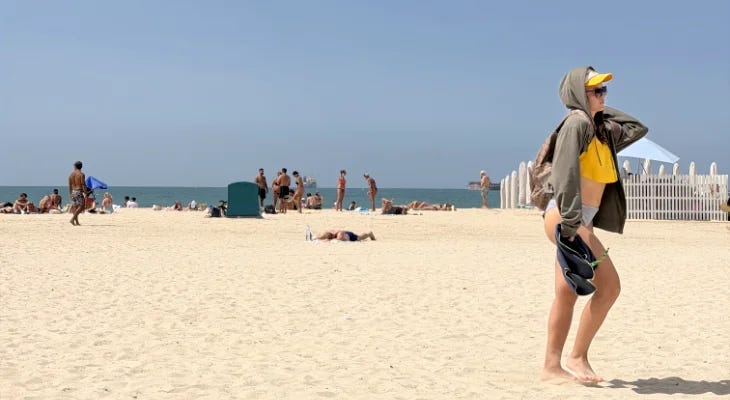
I decide to wait for news from my airline. In the afternoon, we enjoy the beach, hoping to escape the missile alerts. That evening, we stay up late together as a family, caught up in the naive joy of Westerners oblivious to the insidious spread of war around us.
Originally, I had chosen these dates for our holiday in the hopes of enjoying the special atmosphere of this month of Ramadan. But two days after the strikes begin, a sense of lethargy hangs over the streets of Dubai. The heart of Gulf capitalism is in slow motion. Even the Deliveroo and Careem delivery riders, who usually fill the streets, have parked their bikes early in the evening. Too bad for the ravenous stomachs awaiting deliveries.
I still haven’t made a decision about how and when to leave. Wait for a call from the French consulate, hope for a flight offer from the tour operator, or leave Dubai by road? The days go by. Reality catches up with me. My return date has passed. At the hotel, I have to pay for the extra nights.
The High Cost of Escape
I’m looking for plane tickets, but the fares are exorbitant, and the information is contradictory. Flights are trickling into Dubai or Abu Dhabi. Nothing to Bahrain. Some French citizens fled on the very first day starting by car via Muscat (in Oman). The trip takes six hours: just passing through the border checkpoint, which is swamped with people, takes over three hours.
After two days of searching, I find a flight to London from Muscat, going via Jeddah in Saudi Arabia. With the crisis, it’s not just airfares that have skyrocketed. We’re talking $1,200 just to drive to Muscat. One of my friends hooks me up with a more affordable driver. Just thinking about the trip is already exhausting me. But I have to go home.
We spend the night in Muscat at a cheap hotel, just a stone’s throw from the airport. Many tourists, both Asian and European, are staying there. They all share the same concern: will Oman close its borders? An announcement: some flights have just been canceled. The next day, we arrive at the airport, not exactly reassured. A long line of Spanish tourists suggests more delays ahead. Entry is restricted. Only travelers with a ticket are allowed in. Against all odds, we get through.
The airport looks new. Palm trees line the entrance. It’s empty, too. We’re a far cry from the crowds we’d been warned about. We breeze through check-in and customs without a hitch. It takes no more than 10 minutes. The journey seems to be coming to an end. Once at the gate, many French passengers mingle with pilgrims heading to Jeddah and Mecca in Saudi Arabia. I hope to avoid flying too close to Riyadh and the Prince Sultan military base, south-east of the capital, where several ballistic missiles had been intercepted in the preceding days. The plane flies past the city. I’m relieved, but it doesn’t last long.
A Medical Emergency
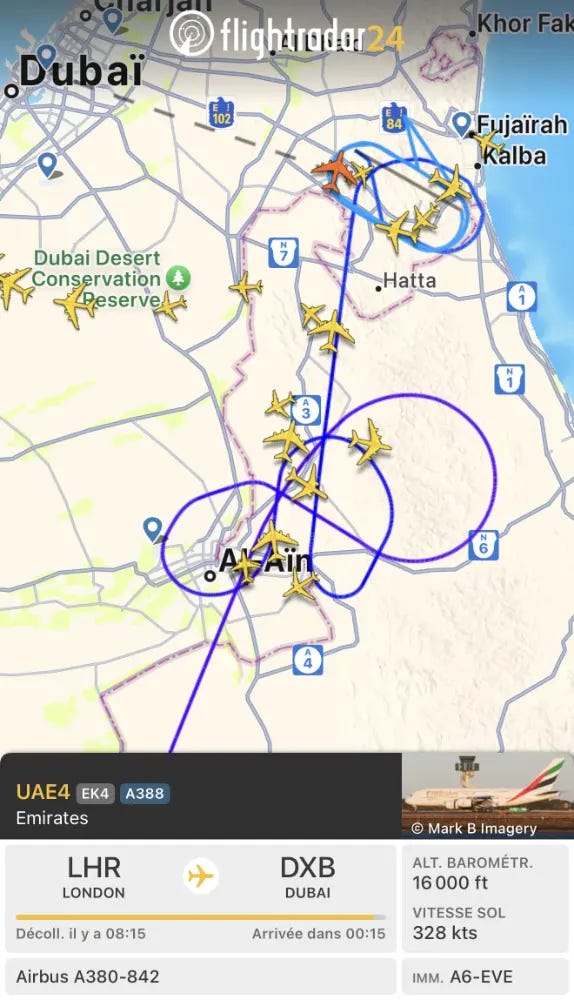
Mid-flight, we’re urgently diverted to Riyadh. A man has fallen ill. Once we land, emergency personnel take him into their care. The plane is grounded for three hours on the tarmac. We won’t make our flight to London, I think, philosophically. Oh, well. It’s refueled, but some unruly passengers delay the departure. It’s hot, but miraculously, no babies are crying. The plane takes off three hours late. I don’t have internet.
Will the flight to London wait for us? I let the crew know, and they admit there’s nothing they can do. Once we land in Jeddah, I rush to the departure lounge. The next flight is delayed, too. What luck! We arrive in London after a six-hour flight. I know the city well, but it’s my first visit to Heathrow Airport. A strange feeling comes over me. I’m leaving a war zone, almost 6,000 kilometers from London. Just over two hours on the Eurostar and I’m back home in Paris. Yet the relief is only temporary.
History has shown that this situation will eventually backfire on us. War doesn’t end just by turning our backs on it, by jumping on a plane and returning home.

I felt like I was living thoses moments! It must have been traumatizing....