

Just a decade ago, the international geopolitical landscape still resembled the one shaped during the Cold War. Today, however, global power dynamics are in flux: erstwhile enemies are cozying up to each other, former friends have fallen out, and countries previously overlooked are asserting greater influence.
It’s a particularly unstable time for Europe, which is struggling with a rise in far-right political parties across the continent, as well as the fallout from wars in Ukraine and the Persian Gulf. It is also grappling with the overriding questions: when will things settle down and what will this new order look like?
Mark Leonard, co-founder and director of the European Council on Foreign Relations, believes it’s too early to ask. “I don’t think that we’re going to see a new order emerge soon,” he says. “I think what we’re going to have is much, much more disruption.”
Mark Leonard, author and co-founder and director of the European Council on Foreign Relations, talks with RFP Deputy Editor Elaine Cobbe
Global Disruption
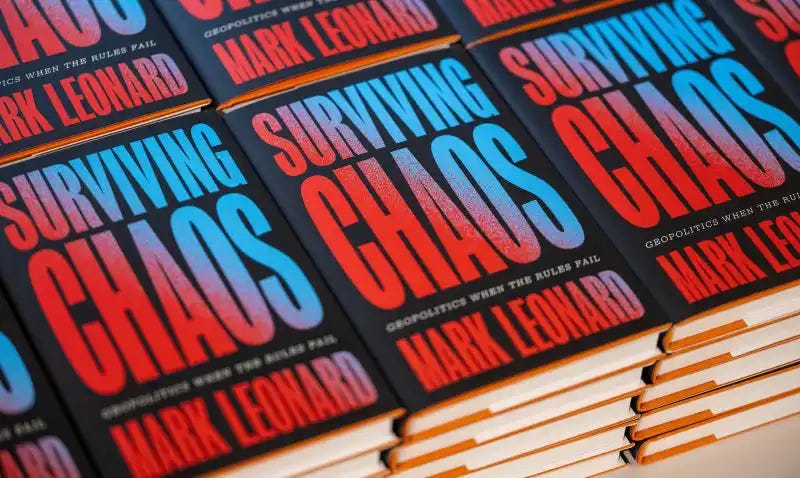
Leonard is the author of a new book, Surviving Chaos: Geopolitics When the Rules Fail. He predicts that “disruption” will generate global disorder for the next few decades…
He thinks we are currently in a situation where there is no balance of power: “There’s no agreement on what the rules are. To say that the Iran war is illegal is just not an argument that has any weight in the American or the Israeli political system. And if you look at what Iran’s doing, you know, its response was to attack countries that were belligerents, like Israel, and the UAE, co-belligerents, and then equally attack countries like Oman, which had absolutely nothing to do with it and were acting as brokers between them.”
Talking to journalists from the Anglo-American Press Association in Paris, Leonard said he believes the old order has broken down so quickly that it would be very difficult today to replicate the kind of international co-operation that galvanized the world during the Covid pandemic or the united opposition to Russia’s invasion of Ukraine in 2022.
France: International Coordination Needed
Speaking at the European Political Community Summit in the Armenian capital, Yerevan, this month, French President Emmanuel Macron shared that perspective, citing the importance of the United Nations, the Council of Europe, and the European Union.
Referring to the US-Israeli attack on Iran in February, where the United Nations was not consulted and allies weren’t even informed, Macron warned: “No peace can be negotiated in any office if it’s based on the idea of ‘might makes right.’”
France has been placing itself at the forefront of EU diplomacy, in an effort to retain Europe’s status on the world stage. The other half of Europe’s power couple, Germany, was absent from the early reaction to the invasion of Ukraine, as it was preoccupied with domestic politics. However, Germany, too, is now keen to signal that it’s back. Chancellor Friedrich Merz was harshly critical of the attacks on Iran – and the US Secretary of Defense responded promptly by threatening to withdraw 5,000 US troops stationed at bases in Germany.
Leonard believes that France may have a harder time than some other countries in coming to terms with these shifts in its relevance. “France has realized for a long time that the only way it could have a seat at the global table – and be important as its relative economic and military power decline – was through Europe,” he says. “And that’s a lesson it has to learn again.”
Consequently, he feels that President Macron is taking the right approach: trying to persuade the French that sovereignty is best preserved by supporting a more united Europe, rather than considering Europe a threat to sovereignty, as the French far right has suggested.
“I think we should be focused on what we can control and what we can do,” Leonard adds, admitting that may be a bigger challenge for France, given that universalism is so much part of the French system. He would like to see France move from that view “to more of a kind of exceptionalism, where we understand that we built something really wonderful and special in Europe, but it is under threat.”
UK: Drawing Closer to EU?
If the European Union has been struggling to understand its evolving relationship with the US for several years, the UK has only recently begun to accept that its “special relationship” with the US is simply not what it used to be. Leonard believes that the growing realization in London that it can no longer rely on the US in the same way has been narrowing the massive rift caused by Brexit, drawing Britain closer to the EU.
“Trump’s ‘second coming’ has just blown apart Britain’s ideas of how it plays a role on the global stage,” he says. “The fact that Britain wasn’t remotely consulted before the Iran war, the fact that the deals they thought they had over the Chagos Islands [Indian Ocean] get, kind of, ripped up, the abuse which Trump levels at British leaders on a daily basis…”
On the defense front, not everyone believes that the Atlantic alliance is finished, no matter how strained relations have become under the Trump administration.
“Europe needs the United States for now, even a transactional United States, even one that has changed the terms,” argue Jackson Janes and Markus Ziener of the German Marshall Fund. Writing in the Just Security newsletter of the non-partisan think tank, they add: “Managing that dependency intelligently is not appeasement, it is realism. It means paying the subscription fee while simultaneously working to renegotiate it from a position of growing strength.”
Trade Bazooka Against China?
Leonard is also concerned about China’s increasing global dominance and warns that Europe is particularly vulnerable to “economic coercion” from Beijing. He would like to see tougher controls and the use of the EU’s anti-coercion “bazooka”, including across-the-board tariffs on Chinese imports to Europe.
He believes that China is better prepared than Europe for this period of disorder. “China thinks that we’re entering a series of changes as profound as the industrial revolution,” he says. “But their hope is that this time they’re going to be on the right side of these changes, and that this could be the beginning of the West’s or Europe’s century of humiliation.”
Leonard argues that the Chinese have a different way of thinking about order – adapting to the world rather than trying to control it – and he would like to see Europeans follow suit.
Closer integration within Europe can help the Old World survive the chaos, he suggests: “I think the European Union is an enormous asset for everybody in this kind of dangerous world where the global rules have disappeared, but where we can still have rules on our continent, and we should entrench them and make them more legitimate and more effective.”
That may require a double think, he says: “You need to have one way of thinking about what happens within our space, and another way of thinking about what happens outside our space.”
