

PARIS: Targeting Vacation Rentals
Population: 2.05 million intra muros

Galeries Lafayette attracts millions of shoppers and tourists to Paris every year [video © Shellie Karabell]
As the world’s most visited country, France attracted a record-breaking 102 million international tourists in 2025 – and at its heart, of course, is Paris, which continues to captivate travelers from across the globe.
The French capital seized the opportunity to become a destination at the very dawn of tourism, appealing to young English aristocrats from the early 18th century. Once the Revolution and the Napoleonic regime had run their course, tourism spread rapidly among economic and social elites in the 19th century: the transportation and hotel industries developed, luxury hotels sprang up, and travel agencies emerged, such as the company founded by Thomas Cook in 1841.
Jobs were created, rules and governance were established, and the Paris Tourist Office was founded in 1971 at the instigation of the City of Paris and the Chamber of Commerce. (For more on the history of Paris tourism and its impact on society, read this massive compendium in French: “Tourism in Paris: what place for the inhabitants?”)
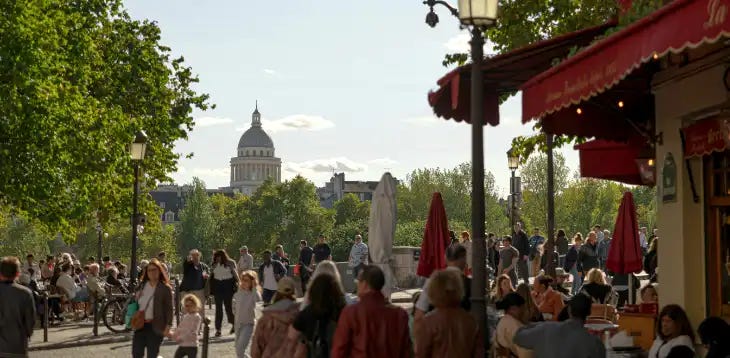
Today, the city’s tourism policy is focused more on managing tourism rather than attracting more of it. The biggest anti-overtourism measure is cracking down on short-term rentals like Airbnb – a major part of the campaign promise of the new mayor, Socialist Emmanuel Grégoire, to protect housing, neighborhood life, and public spaces. Those who stay in hotels are paying their share: the per-night per-person tourist tax increased this year totaling as much as €15.93 for a top-rank “palace” hotel and €11.70 for five-star.
Paris now treats overtourism and housing policy as linked issues, in the belief that too much housing has been shifted toward tourism-related uses at the expense of residents. (Ed’s note: So many residents have left arrondissements 1, 2, 3, and 4, in the center of the city, that the four have been grouped into one administrative unit and renamed “Paris Centre.”)

Cutting Back on Vacation Rentals
To foster housing affordability and preserve residential neighborhoods, the city has:
Reduced the annual limit for renting out a primary residence as a tourist rental from 120 days to 90 days (from 2025).
Required registration numbers for short-term rental listings.
Increased monitoring and enforcement powers under new legislation.
Imposed large fines on unauthorized tourist rentals.
Increased the tax on secondary residences and restricted the conversion of those residences into full-time tourist accommodations unless owners obtain special authorization.
Created a dedicated housing-protection enforcement unit.
In addition, a small but symbolic measure was the city’s 2025 ban on key lockboxes attached to public street furniture, which came to symbolize the proliferation of Airbnb-style rental locations.
Electronic Monitoring
Stronger data and enforcement tools provide greater monitoring with:
Centralized registration systems.
Platform data sharing.
Automated tracking of rental-day limits.
Easier identification of illegal listings.
Rather than aggressively trying to keep tourist numbers down, Paris seems to follow a regulation-and-enforcement approach: the city welcomes tourism but aims to prevent residential neighborhoods from turning into year-round hotel districts.
Be sure to check out Deputy Editor Elaine Cobbe’s video report from Montmartre, as an example of how overtourism is affecting one Paris neighborhood, and join Production Assistant Edie Twells-Eastwood as she chats with tourists around Paris.