


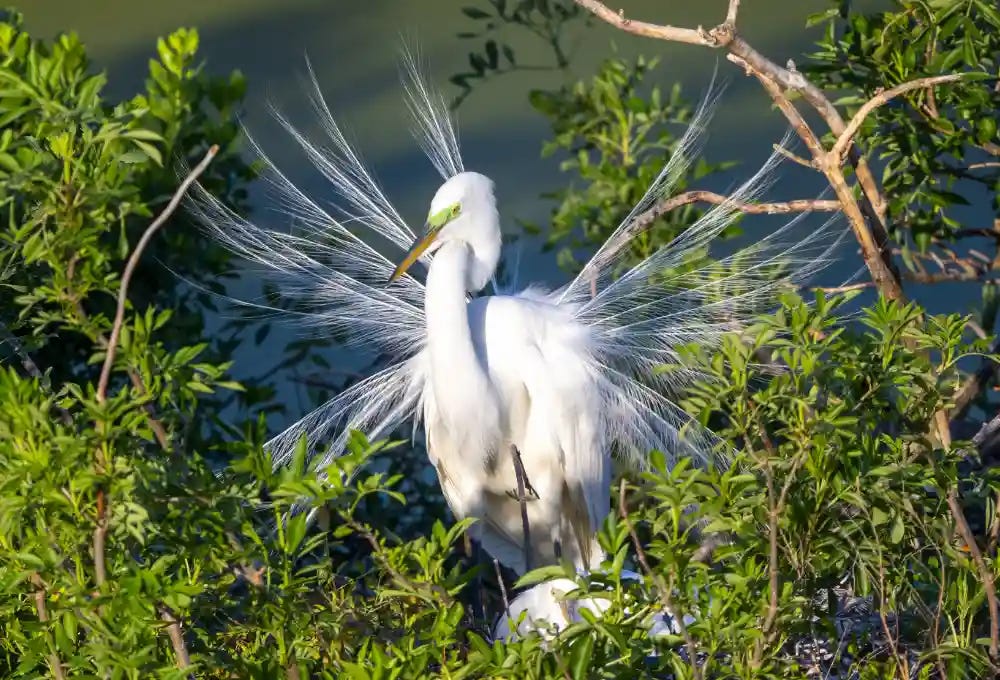
It would be easy to blame the 18th-century queen of France, Marie-Antoinette, and her penchant for outrageously tall and often-feathered headgear, for the surge in demand for bird feathers. As the era’s chief fashion influencer, the queen set the trends for her court and aristocratic hangers-on. But it wasn’t until the Industrial Revolution created a growing middle class, with disposable income and social ambitions, that wearing feathers became a popular status symbol. That spike in demand increased the number of Parisian plumassiers – artisans who fashioned feathers for haute-couture masterpieces for wealthy clients – from around 25 in the late 18th century to hundreds just a century later.
This fashion frenzy for feathers wreaked havoc on birds. Many Great and Snowy Egrets, with their delicate spray of breeding feathers, were killed for the stunning plumage they naturally grew to attract mates during breeding season. Colonies of thousands of adult birds were killed on site, leaving four to six abandoned chicks per nest, endangering future generations, and paving the way to extinction.
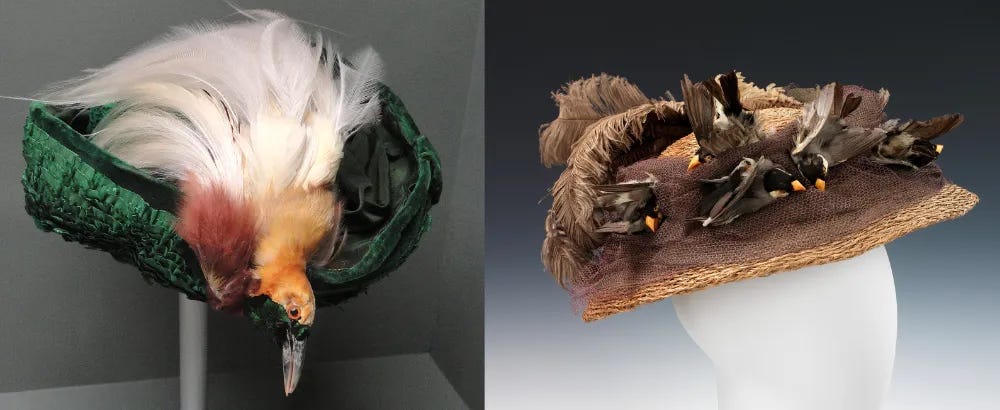
To give just one example, according to the scientific journal The Auk, rookeries in Florida were empty and silent by 1887 – a drastic and ominous change from the raucous cacophony of bird calls from thousands of nests (such as in the video below of the rookery at Little St. Simons Island, Georgia, USA). Birds were disappearing globally at an alarming rate.
[video: Scott Coleman]
An Unlimited Market
Still the trade grew. Feathers and bird skins from common and exotic species were imported in wholesale quantities from around the world to feed fashion’s demands. London was the epicenter of this trade that decimated dozens of species including grebes, terns, parrots, manakins, albatross, and even condors. Iridescent hummingbirds, taken from South America by the tens of thousands, were taxidermized and fastened whole onto women’s hats.
While feathers may have been lightweight, the market for them was anything but. Historian Malcolm Smith notes that at the end of the 19th century, the London feather trade was worth £20 million a year (approximately £2.5 billion/$3.35 billion today) representing at least 200 million birds killed annually worldwide. Economic ornithologist Herbert K. Job wrote that in 1902 a single London auction house sold 48,240 ounces of feathers, equal to 192,960 egrets killed at their nests plus two to three times that number of eggs or chicks. Worth twice their weight in gold by 1903, feathers became the trophy of a deadly global trade.

Evolving in isolation, the refined, specialized feathers of Birds-of-paradise exclusive to Papua New Guinea were the rarest and most coveted. Between 1905 and 1920, 30,000 to 80,000 of these skins were exported annually to Europe, bringing the birds to the brink of extinction. Zoologist William T. Hornaday mentioned this silence, writing in 1913 of a colleague’s comment: “One can now walk miles … through the former haunts of these birds [of paradise] without seeing or hearing even the commonest species.”
The Tide Turns
The 19th century also saw a growing appreciation of nature, Victorian concern for animal welfare, and women’s reform movements combined with the realization that nature wasn’t unlimited. As news spread about the scope and cruelty of the feather trade in the 1890’s, women such as Emily Williamson in Britain and Harriet Hemenway in the US mobilized against the slaughter.
By the 1920’s, laws in Europe and North America restricted feather importation. The French fashion industry resisted restricting its luxury fashion tradition until 1978 when it ratified the CITES (Convention on International Trade in Endangered Species) framework.
Though the feather trade helped push Carolina Parakeets and Great Auks to extinction, generations of protection show results: some species, including Great Egrets and Raggiana Birds-of-paradise, are no longer endangered.
While fashion still has advocates for real feathers and animal products, increasing concern for nature and animal welfare is driving demand for sustainable alternatives. Today, innovative designs using faux fur, plant-based leather, synthetic faux feathers, and laser-cut textiles that mimic the beauty, vibrant colors, and movement of natural plumage are readily available. This has helped to create a new world of style for modern fashionistas valuing ethical alternatives that respect and are inspired by nature.
For more information:
In England, in 1889, Emily Williamson founded what became the Royal Society for the Protection of Birds (RSPB).
In the US in 1896, Harriet Hemenway and Minna Hall formed the Massachusetts Audubon Society; in 1905, the National Audubon Society was established.
In France, in 1912, a conservation organization that was formed after Atlantic Puffins were decimated in the Sept-Îles archipelago by feather traders and puffin-hunting tours became the Ligue pour la Protection des Oiseaux (LPO).
In 1922, these organizations coordinated international action addressing various issues, including the feather trade, and founded the International Committee for Bird Protection (ICBP) – now Birdlife International.

Once the truth came out how many birds were brutally dying en masse for fashion it triggered a reaction that was fundamental to the beginnings of the conservation movement. A silver lining!
Makes conservation efforts seem even more worthwhile.