


When François-Joseph-Paul, Comte de Grasse, Marquis de Grasse-Tilly, an admiral in the French Navy, set sail with his fleet on March 22, 1781, they had a long journey ahead of them. Bound for American waters, to join General George Washington and French General Rochambeau, who were conspiring to beat the English, they would eventually anchor in May in Saint-Domingue (now Haiti) – more than 4,000 miles away.
During this epic voyage, in his case on board a multi-storied ship called La Ville de Paris, he and his crews needed to eat. And, as his reputation for bravery and professional skill would suggest, he viewed proper nutrition as an important element in his new expedition, upon which rested the fate of the struggling American colonies.
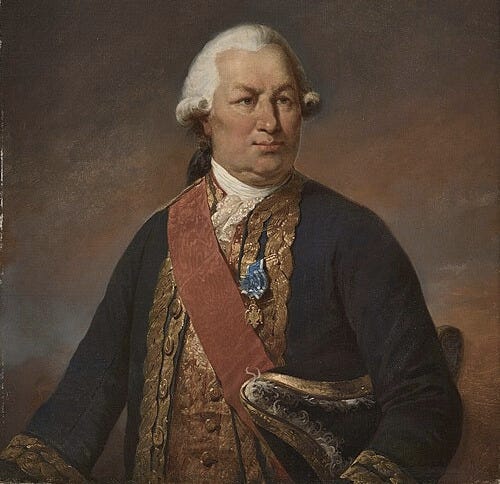
Admiral de Grasse was an aristocrat, as were many French ship captains at the time. The position was one of the various rewards the king could dole out in exchange for what the nobles could give. History tells us that, for the most part, these noblemen were not qualified to plan, steer, fight, lead, or do much more than demand and argue, but Admiral de Grasse was an exception.
An excellent mariner and tactician with much experience, he also took care of his crews. They were Frenchmen, after all, and even on the open seas, the admiral was honor-bound to respect French law. And that included adhering to the legal requirement of ensuring that each crew member had three meals a day, the equivalent of around 3,000-3,500 calories, considered the minimum to keep up their strength.
Live Cows and Ducks, Beans, Cheese…
The journey from France to the Americas could last anything from a matter of weeks to several months, depending on the weather. So, the food had to last.
His ships leaving the continent were laden with nourishment, from thousands of pounds of “hardtack” (unsalted, teeth-breaking biscuits that turned tender when vermin nibbled them into crumbs, which, if the crumb measured the equivalent of an inch, was still considered food) to rounds of Dutch cheeses and Gruyère, flat planks of salt cod and Irish salted beef, salt pork, air-cured hams and sausages, and vats of fermented cabbage.
Sacks of pulses – from peas to beans – were stashed near buckwheat groats and lentils. There were barrels of fresh water mixed with vinegar to keep it palatable, and others of cider, ale, and wine.
Cattle tied to the first mast and ducks held in cages below provided fresh meat for the beginnings of the voyage.
When he set sail from Saint-Domingue for the Chesapeake, food supplies were augmented with, it can be imagined, live goats and chickens, probably coffee, and definitely barrels of rum. Provender for this journey would also have included – along with the ubiquitous hardtack – molasses and rice, sugar cane and chocolate, and pineapples, bananas, guavas, and soursops.
“À Table!” (or “Dinner’s Ready!”)
However, the meals would have been French cuisine through and through – ragouts and soups, pea and bean purées, fish stews, lightened up, one can conjecture, with the bright flavors of the Caribbean such as peppers and ginger.
And while research and hearsay lead one to believe the food was infecté (terrible) aboard ship, perhaps for a few weeks or short months, at least, it would have reflected some well-established French regional dishes.
Imagine giant bowls of Brandade de Morue, a garlic-laden purée of salt cod and olive oil; choucroute (pickled cabbage, which was loaded with vitamin C) topped with salted and cured meats; Boeuf Bourguignon and Pot-au-Feu from the center of France; soups of split peas and beans seasoned with smoked pork; perhaps even a version of Cassoulet. It is said mariners had time to fish, and so there might have been huge pots of fish stew seasoned with bay leaves, brought along to keep the flies away, and grilled sardines or mackerel.
You Are What You Eat
Whatever the French mariners ate before and during that decisive Battle of the Chesapeake on September 5, 1781, de Grasse and his men routed the British fleet from the Bay, setting the stage for the American victory at Yorktown six weeks later. Here is a recipe that might have been part of the key to success:
BRANDADE DE MORUE
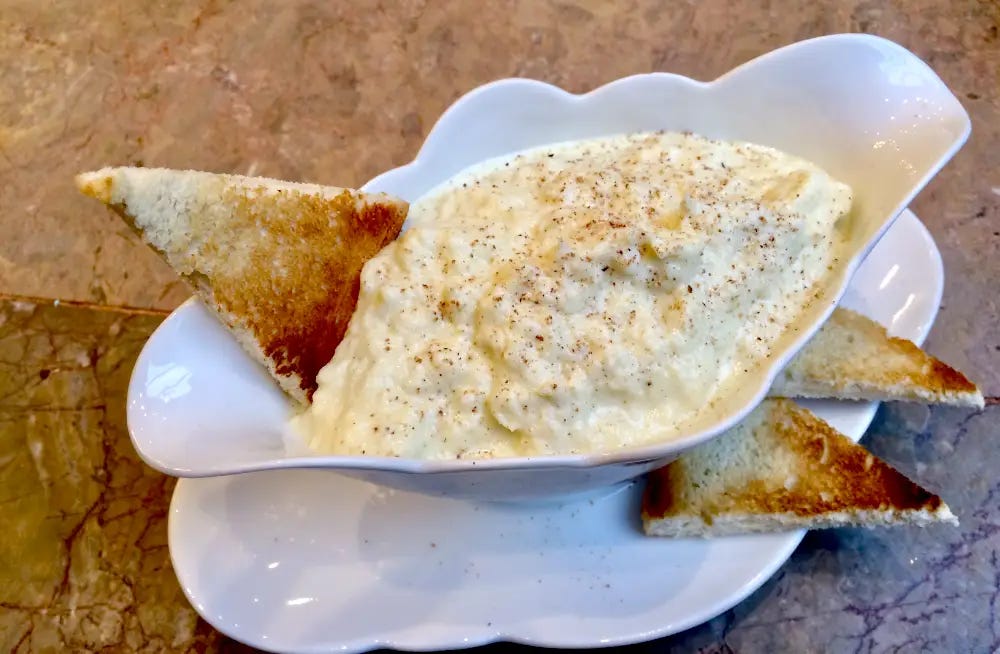
6 to 8 servings
INGREDIENTS:
For the toasts (optional):
4 thin slices of good-quality white bread, crusts removed, each cut into 4 pieces on the diagonal
¾ cup (7g) flat-leaf parsley leaves
For the brandade:
1 pound (500g) skinless and boneless salt cod
1 cup (250ml) milk
1 cup (250ml) extra-virgin olive oil
4 large cloves garlic
½ teaspoon grated nutmeg
2 teaspoons fresh lemon juice
Freshly ground black pepper
4 slices bread, toasted, and rubbed with 1 clove garlic
¼ cup oil-cured black olives
METHOD:
This step is for an optional garnish of toasts. Line a plate with a double layer of paper towels. Heat the oil in a skillet over medium heat. When the oil shimmers, add the toasts and fry until they are golden, which will take a minute or two, then flip until golden on the other side. Mince the parsley and put it in a shallow bowl. When the toasts are golden, using tongs, remove them from the oil, letting any excess oil drip into the pan. Dip one edge of each toast into the parsley, then set the toasts on the prepared plate, and reserve.
Soak the cod in plenty of cold water, changing the water several times, for one to two days.
Drain the cod. Place it in a saucepan and add cold water to cover. Bring the water to a boil over high heat, reduce the heat to medium and cook, simmering, until the cod is translucent through, about 10 minutes. Drain the cod. When it is cool enough to handle, break it into flakes, discarding any skin or bones.
Scald the milk in a medium saucepan over medium-high heat. At the same time, heat the olive oil in a small saucepan over medium heat, until hot but not smoking.
Place the cod and the garlic in the bowl of a food processor. With the machine running, add the hot oil in a thin stream. Pulse on and off, so the cod isn’t over-beaten. When the oil is incorporated and the mixture is quite smooth, slowly add the milk in a thin stream, pulsing on and off to avoid over mixing the brandade. It should be light, white, and fluffy – like pudding.
Add the nutmeg and the lemon juice to the brandade; pulse one to two times. Season with pepper. Scrape the brandade into a shallow serving bowl, mounding it in the center.
Cut the toast into triangles. To serve, arrange the toast triangles with a point up, around the base of the brandade. Garnish with the olives and serve immediately.