

Two Years After the Olympics: Assessing Promised Economic Benefits
Investment in the Paris 2024 Summer Olympics came with a pledge of economic benefit for Seine-Saint-Denis, one of the poorest areas of the Greater Paris region. Locals wonder when it will happen.

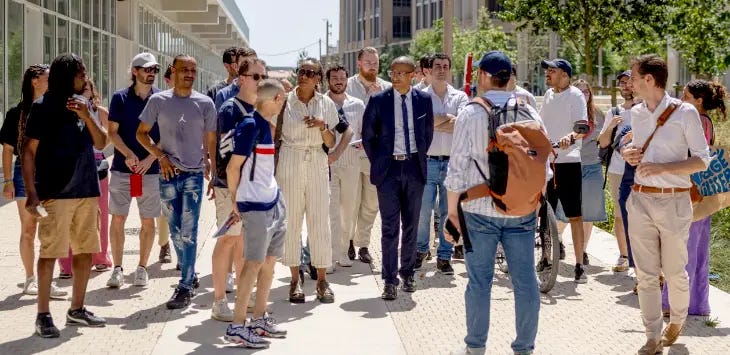
More jobs, increased appeal, economic development: the Olympic vision for Seine-Saint-Denis was glowing. Just five days before the Games began, the mayor of the Parisian suburb of Saint-Ouen, Socialist Karim Bouamrane, called that vision “a particle accelerator.”
As the Games got underway, expectations were high among the government, local elected officials, and economic stakeholders.
Today, Bouamrane claims the vision has been at least partially fulfilled. The Olympics, he tells Reporting from Paris, “accelerated projects that would have taken much longer: the arrival of Metro Line 14 [in Saint-Denis], the transformation and beautification of public spaces, and new facilities for better public services.”

Pinned Hopes
Seine-Saint-Denis is France’s poorest department: more than one in four residents lives below the poverty line (on less than 1,200 euros per month). The municipality of Saint-Ouen and other towns in the region pinned their hopes on the Olympic and Paralympic Games to improve substandard housing (accounting for at least 15 percent of the private housing stock, according to the préfecture) and boost public transport facilities.
Among them is the famous Olympic Village and its 2,800 housing units built across three municipalities: Saint-Ouen, Saint-Denis, and L’Île-Saint-Denis. After hosting nearly 15,000 athletes and support staff during the Games, 25 percent of these units were earmarked for public housing. The rest were intended for resale after the event.
Seine-Saint-Denis is France’s poorest department: more than
one in four residents lives below the poverty line
However, in its report of March 23, 2026, the regional chamber of the Court of Auditors expressed concern about the lack of buyers for these units. The main reason? The price per square meter – around 7,000 euros – was considered too high for the department, where the average is less than 4,000 euros. Olympics aside, property prices here have been rising in recent years: the search for affordable accommodation in Paris has brought gentrification even to areas like Seine-Saint-Denis, putting long-term residents at a disadvantage.
Future Vision
Bouamrane takes the longer view. He believes that “the renovation and rehabilitation of 1,800 housing units in two historic neighborhoods of Saint-Ouen through the ANRU (the National Agency for Urban Renovation) with a budget of 350 million euros, as well as the planned move there of the DGSI [Homeland Security] in 2029, and the future major Paris Cité university hospital campus – which is expected to have 12,500 medical students by 2030 – all these large-scale projects have helped accelerate the town’s development.”
He claims that the Games actually supported a momentum that was already underway. “As early as 2020, we had launched major projects to improve the lives of Saint-Ouen’s residents,” explains Bouamrane, referring to the year of his first election. (He was re-elected in March 2026 with 56.44 percent of the vote and has declared his candidacy in next year’s French presidential elections.)
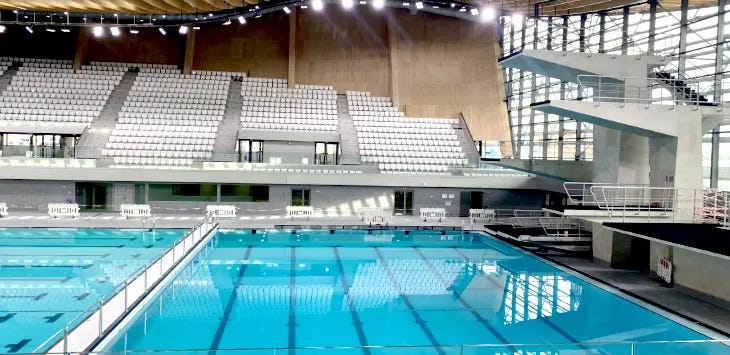
In the neighboring town of Saint-Denis, locals now get to enjoy a very concrete legacy of the Games, as the only permanent Olympic venue built from scratch, the Aquatic Center, opened to the public last summer. The center was specially designed for a variety of water sports and other activities, with the express intention of making it public-friendly for after the Olympic and Paralympic Games. That includes keeping the entrance fee lower than many other Paris municipal pools. As well as four pools, the center houses paddle tennis courts, a climbing wall, and a gym.
Mixed Perceptions
While the region’s image and accessibility may be improved today, the reality is mixed. Following the Games, the independent institution responsible for overseeing French public spending commended the Olympic organization for its management while noting modest economic benefits, with 293 million euros in revenue. Residents of the region, however, expected more, and sooner: an economic boom following the billions in Olympic investment. But the disparity was evident from the start.
Just nine percent of direct hires for the Olympic and Paralympic Games lived in Seine-Saint-Denis, resulting in only modest short-term gains for residents.
Two years later, Bouamrane remains optimistic about what he calls “shared progress.” He insists that “the true legacy of the Games will be measured over the long term – through quality of life, economic appeal, and the opportunities created for the residents of Saint-Ouen and Seine-Saint-Denis.”
