


The Americans and the French both celebrate their independence in July – Americans on July 4th, commemorating the signing of the Declaration of Independence from Britain in Philadelphia, and the French on July 14th, commemorating – depending on which version of history one wants to believe – either the storming of the Bastille in Paris, toppling the country’s most potent symbol of tyranny, or the anniversary one year later of the “Fête de la Fédération,” held on the Champ-de-Mars, ostensibly to celebrate national unity in the early days of the Revolution before thousands lost their heads.
More than any other peoples back in the 18th century, the French of the Enlightenment and the independent-leaning American colonialists upended the idea that kings ruled by divine right, sharing the view that each man was endowed by his creator with inalienable rights, which could not be usurped by a monarch. And so, the long march towards participatory democracy began, much of it in the cafés of Paris.
On a down-to-earth level – the “how do we get this done?” level – there were practical aspects for the rebellious American colonialists to consider, not the least of which was funding and military support. This was not easy for a bunch of colonies still in obeisance to the British Crown, with limited ways of raising money and even fewer ways of raising an army. These needs coincided very nicely with the interests of a young French military officer looking for a just cause to support – an aristocrat who went on to become George Washington’s closest attaché and unofficially his adopted son.
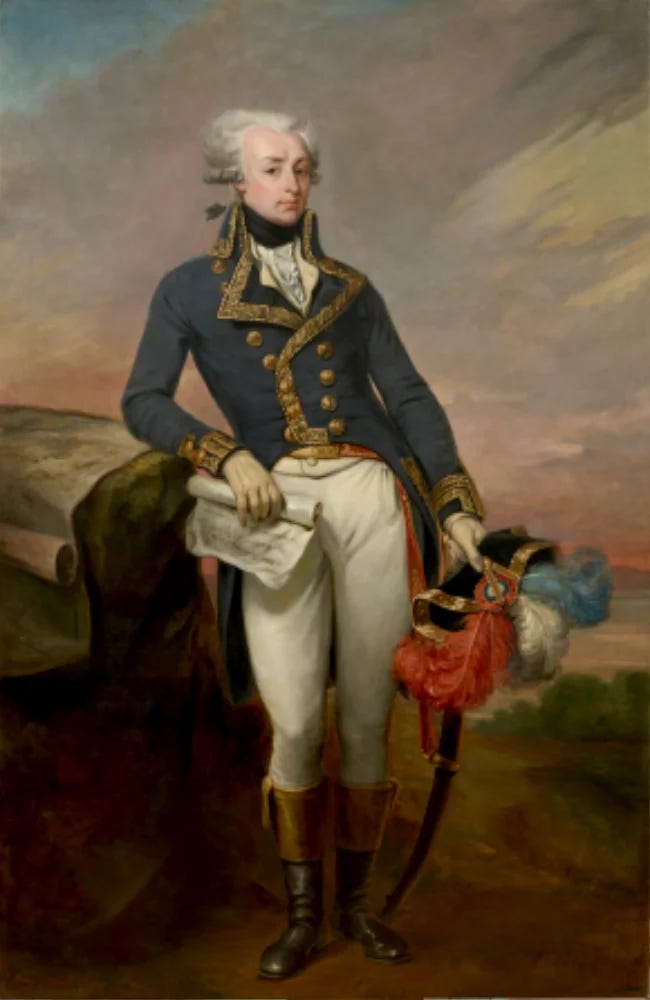
The man is Marie-Joseph-Paul-Yves-Roch-Gilbert du Motier, Marquis de Lafayette, born September 6, 1757, at the Château de Chavaniac in the Auvergne mountains in central France. He is referred to in France as the Marquis de Lafayette. In the US, he is simply “Lafayette.”
The Aristocratic Revolutionary
An unlikely revolutionary, this son of one of France’s oldest families – his forefathers fought in the Christian crusades and supported Joan of Arc – was orphaned and a millionaire by age 14, married to the love of his life at 16 (Marie Adrienne Françoise de Noailles, herself from a distinguished family), a major general in the United States Army at 19, and famous on both sides of the Atlantic by the age of 20.
His introduction to the American revolution came not from the French army (in which he was a member of the officer ranks) but at a dinner party in Metz, where he was cooling his heels when the 1775 military budget cuts in France jettisoned him from active service.
There, he met the younger brother of Britain’s King George III, the Duke of Gloucester, who regaled the 17-year-old French officer with derisive tales of the colonialists’ belief in their right to self-rule, their mounting of a Continental Army under George Washington, and mocked their revolutionary beliefs. “My heart was enlisted,” Lafayette wrote in his memoirs, adding his desire to “join my colors to those of the revolutionaries.”
Benjamin Franklin had already been in Paris drumming up support for American independence – so successfully that pundits at the time claimed there was more support for George Washington in France than in all of the Continental Army. The rights of man were on the minds of people on both sides of the Atlantic.
Off to America
In early 1777, aged 19, Lafayette set sail for America – hiring ships at his own expense and paying the way for his entire company. His family were opposed to the idea, calling Lafayette’s youthful display of impatience, desire for glory, and idealism “first-rate idiocy” – especially as the young captain was leaving behind his young, pregnant, and highly-born wife. The family turned to King Louis XVI to stop him, but Lafayette went anyway… and it is interesting to note that French society chose to applaud rather than castigate this derring-do of the young knight-errant.
Lafayette’s reception in Philadelphia, however, was not an immediate success: Congressman James Lovell of Massachusetts had by now grown sick of what had become a steady stream of gallant Frenchmen seeking a good fight and glory in the colonies, and at first refused to see Lafayette. That changed when Lovell was made aware of the French captain’s vast wealth and excellent connections, and Lafayette was finally introduced to General George Washington. The two men almost immediately struck up a close relationship – Lafayette seeing in Washington the father he had never known (his own was killed during France’s Seven Years’ War with England when Lafayette was 14) and Washington referring to Lafayette as “my son.”
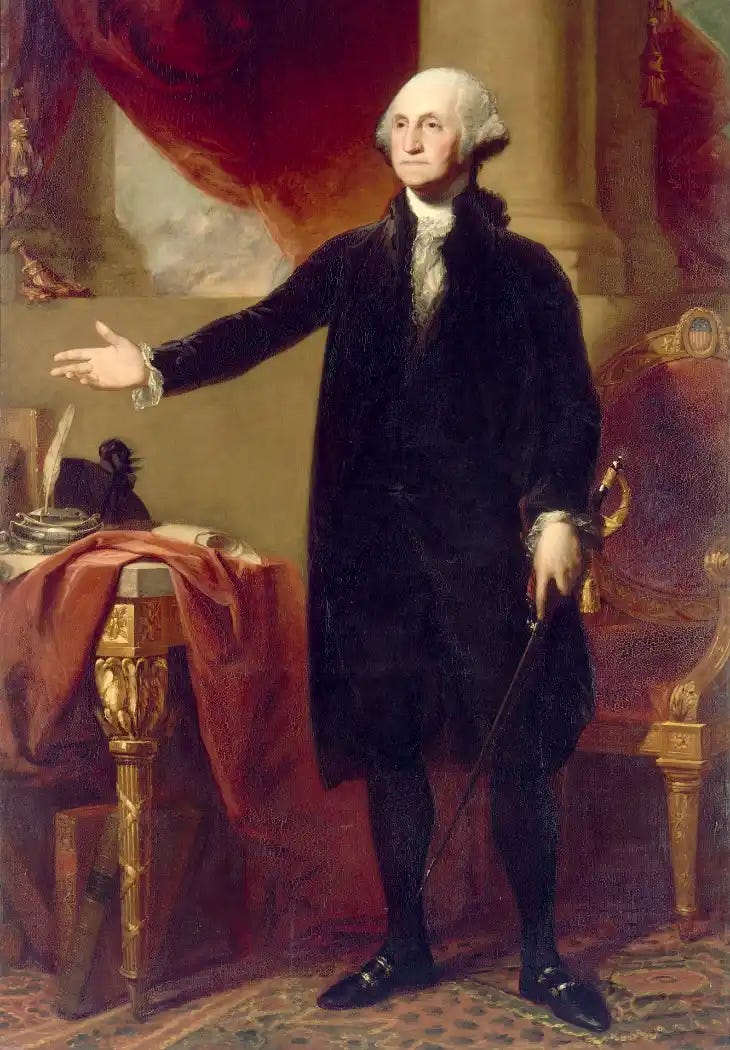
He also became enchanted with the country itself. Writing to his wife on June 19, 1777, Lafayette described America as an idyllic land where “the simplicity of manners, the desire to oblige, the love of country and of liberty” were the dominant characteristics of the people, and where “sweet equality … reigns over all.” Lafayette’s first extended sojourn with an American community deepened these beliefs.
Fighting alongside Washington and the Continental Army against General William Howe in the Battle of Brandywine (Pennsylvania) in September of 1777, Lafayette was wounded in the leg. He was nursed back to health by the Moravian Brethren in Bethlehem (also in Pennsylvania) whom he described in a letter to his wife as “an innocent family” that managed to maintain its “community of goods, education and interests” despite the devastating war around them.
Lafayette then joined American General John Sullivan at Valley Forge that winter and developed close friendships with Thomas Jefferson and Alexander Hamilton.
Sending in the Troops
Lafayette’s flamboyant exercises and close relationships in America, coupled with Benjamin Franklin’s diplomatic efforts in Paris and Washington’s victories in Sarasota, finally resulted in solid French support for the American cause. In February 1778, Louis XVI signed a treaty of alliance with the United Colonies of America, and the French court at Versailles recognized American independence on March 20, 1778. This was an important step and Lafayette knew it, rushing back to France in 1779 to convince Louis XVI and the court that now was the time for France to commit its military and money in support of America’s war of independence from their common enemy: Britain.
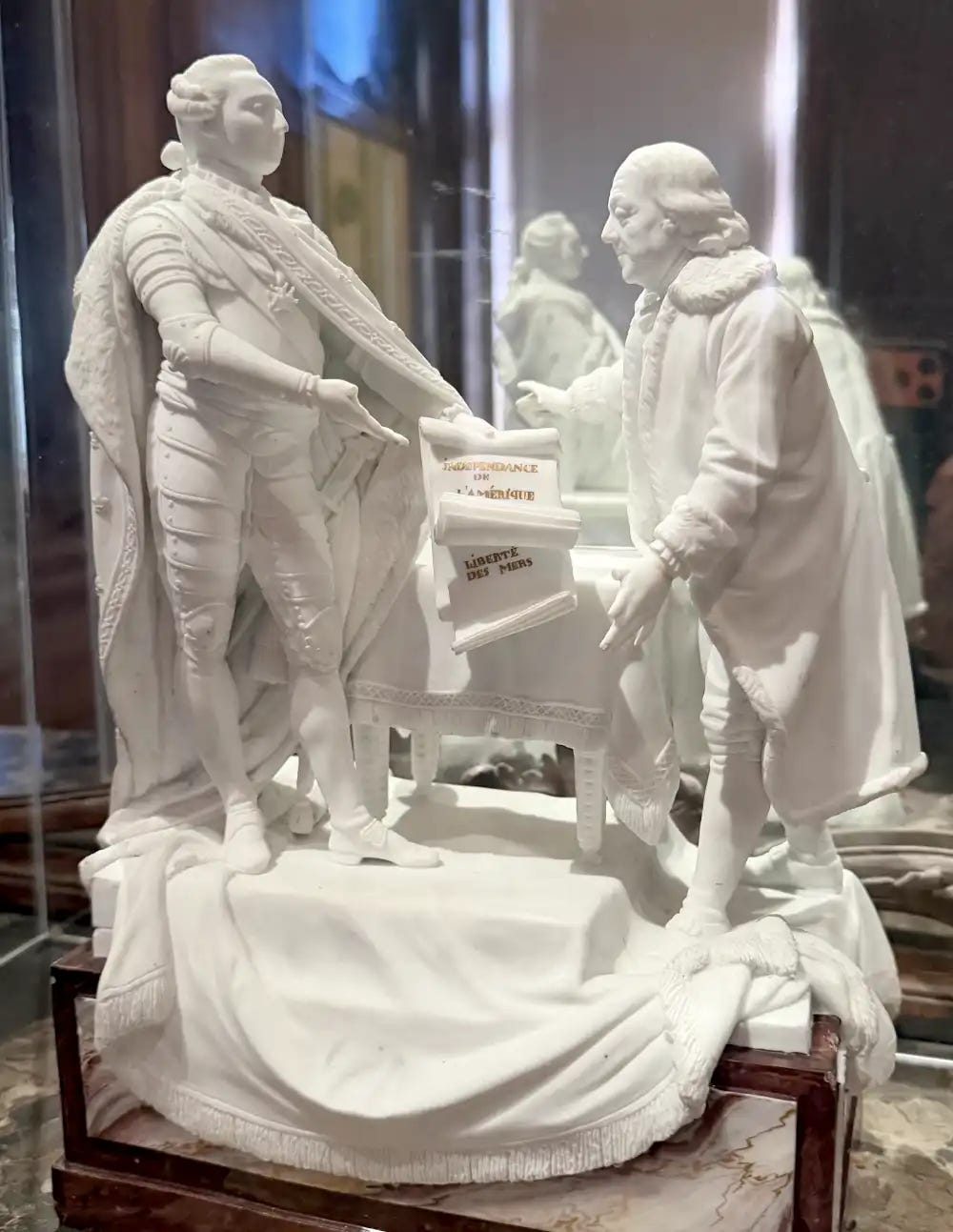
By now, Lafayette also had the support of French Secretary of State for Foreign Affairs, Charles Gravier de Vergennes, who viewed supporting American independence as an opportunity for revenge against Britain after the French defeat in the costly Seven Years’ War that had caused France to lose many of its land holdings in North America.
When Lafayette returned to America in May of 1780, it was as an official representative of France, bringing with him a French military expeditionary force of some 5,500 men under the command of Jean-Baptiste Donatien de Vimeur, Comte de Rochambeau to operate in coordination with General Washington’s troops. Admiral Francois-Joseph Paul, Comte de Grasse. arrived in May of 1781 with the French Navy (read Susan Herrmann Loomis on “what they ate” elsewhere in this edition of Reporting from Paris). Despite being better trained, better armed, and more experienced than the Americans, the French military and its aristocratic leaders agreed to serve under General Washington. Their target was another aristocrat: British Lieutenant General Lord Charles Cornwallis.
By Land and by Sea
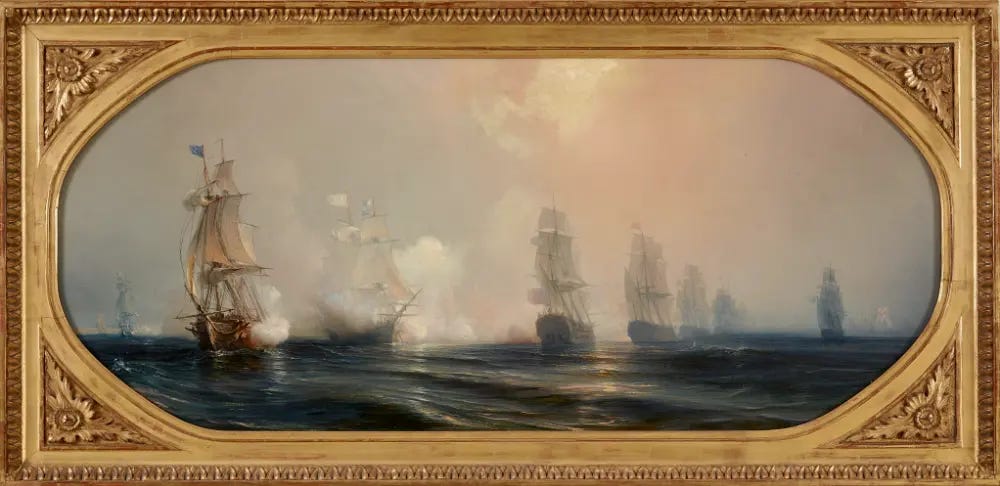
Thereafter, victories were swift. In late September, Admiral de Grasse’s decisive naval victory routed the British fleet of Rear-Admiral Thomas Graves off the Virginia coast of Chesapeake Bay, leaving Cornwallis with his unprotected back to the sea. This gave the insurgents time to plot the strategy that would entrap the British at Yorktown, Virginia.
It was there, on October 19, 1781, hemmed in on land by some 16,000 Allied troops and cut off from escape via the water by de Grasse’s ships, that Cornwallis laid his sword at the feet of George Washington and surrendered with his 8,000 men. The Articles of Capitulation were signed at Moore House in Yorktown that day, abandoning any chance of British victory in the American War of Independence.
Three commanders who needed a translator to communicate with each other (Lafayette, as a major general of American forces, served as a liaison, of course) had defeated the world’s mightiest military. Lafayette was just 24 years old.
On September 3, 1783, the Treaty of Versailles officially brought the war to an end.
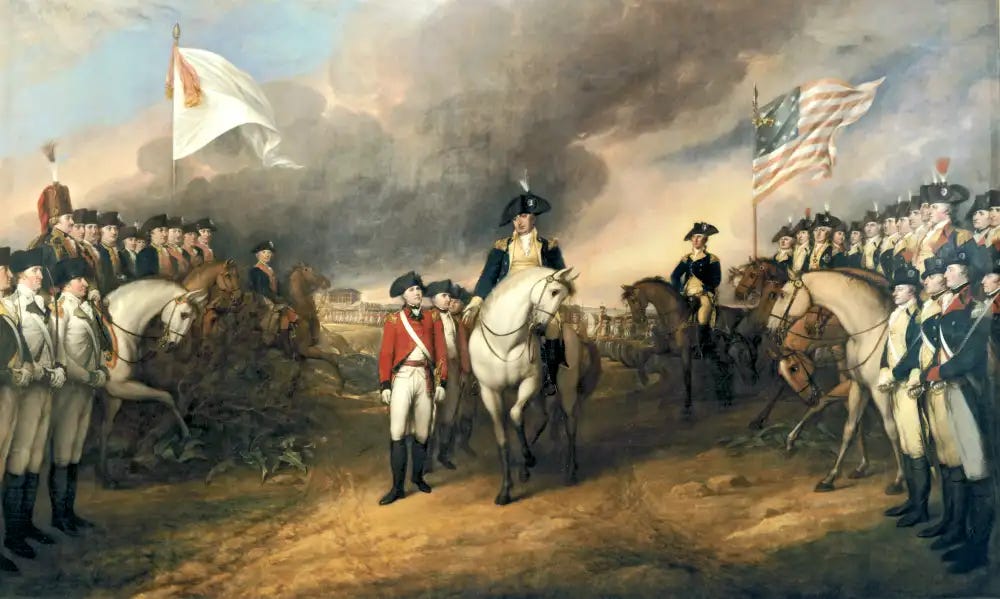
Washington and Lafayette – two men, from two different countries and of two different generations, sharing a common commitment to liberty and to the rights of man – had changed the world.
After the War
Lafayette’s ties with America did not end with the victory at Yorktown. While most of the French officers who fought in the War of Independence returned to France and the careers they had left behind, Lafayette made America his life’s work, promoting friendship and trade between France and America and serving as the new nation’s foremost advocate in France. His written complaints to officials in Paris about the French way of doing business – “the intricacies of our regulations are even more annoying than their cost” – are familiar words today!
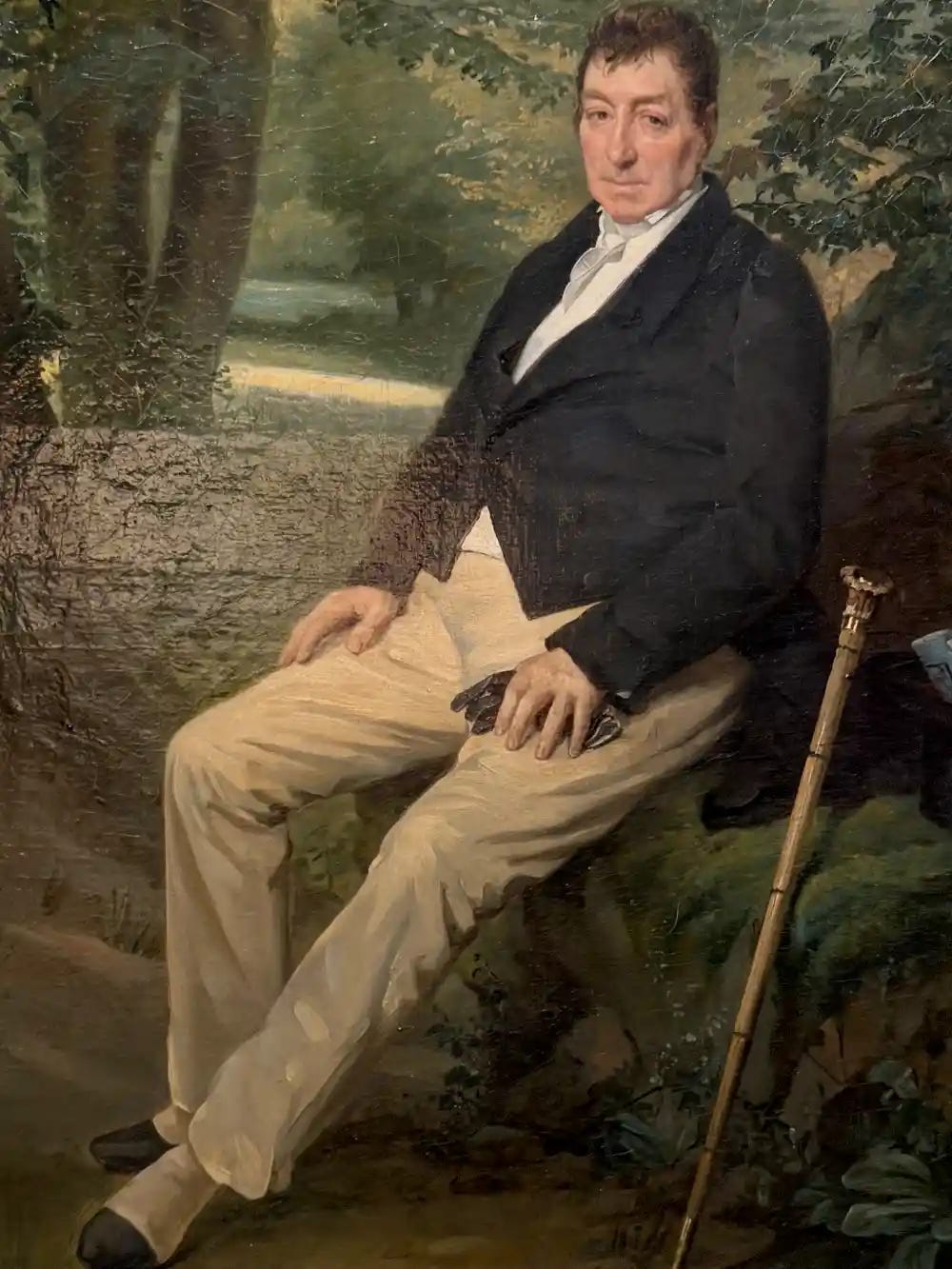
Lafayette’s affinity for America and Americans went deep. He referred to himself as an American citizen (he wasn’t, during his lifetime). He named his son George Washington Lafayette, and one of his two daughters Virginia, after the state where the battle of Yorktown took place. (Ed’s note: Virginia’s full name was Marie-Antoinette Virginie Lafayette)
A Farewell to Comrades-in-Arms
Washington and Lafayette last saw each other in 1784, when Lafayette left America to return to France. His Paris townhouse in Rue de Bourbon became a gathering place for the Jeffersons, the Adamses, and the Franklins. A gold-engraved copy of the Declaration of Independence hung on the wall of his study.
Lafayette sent Washington the key to the Bastille when that symbol of royal tyranny was overthrown in the debut of France’s own revolution on July 14, 1789. With his military experience during the American Revolution, the now-32-year-old Lafayette quickly assumed a prominent role in the opening chapter of the French Revolution, serving in the National Assembly and commanding the Republican Guard (Garde Républicaine), formed to keep order throughout France. It is very likely that his time serving under Washington as a major general in the Continental Army provided much of the inspiration for France’s “Rights of Man,” which Lafayette wrote, and which survives today as a key doctrine of French democracy.
However, Lafayette did not believe France should follow the American model in pursuing its own revolution. Writing to Thomas Jefferson in 1789, he pointed out that Americans had “the advantage to work a new ground…” Europeans, in contrast, “had lived in a state of corruption for so many centuries that they could not easily be extracted from it.” It was his support for a constitutional monarchy rather than a republic that eventually saw him branded a “royalist” in France, forcing him to flee to Austria, where he was immediately incarcerated as a “dangerous radical.”
Though he lived through some of the most turbulent times in the history of the world, Lafayette was steadfast in his beliefs. He anticipated and supported causes for freedom, defending Native Americans and Black people in America, Protestants and Jews in France, human rights and universal suffrage, openness, and the quest by the Irish, Poles, and Italians to create their own nations.
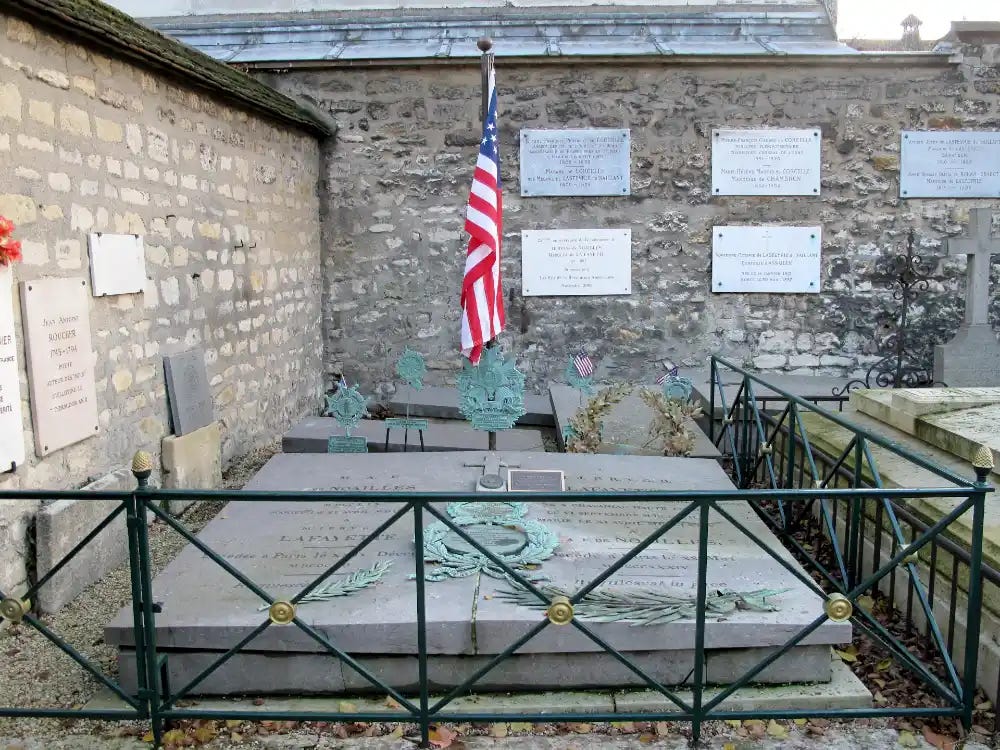
Lafayette returned to the US for the last time in 1824 at the age of 67 (Washington had died in 1799), toured all of the then-24 states, and returned home to France, where he died in Paris on May 20, 1834. He is buried next to his wife Adrienne in Picpus Cemetery in the eastern part of Paris. He was made an honorary US citizen in 2002. A plaque at his grave indicates it is maintained by the Daughters of the American Revolution. An American flag flies overhead.
Postscript:
General Jean-Baptiste Donatien de Vimeur, Comte de Rochambeau, supported the French Revolution but was arrested during the Reign of Terror (1793-94) and imprisoned in the Conciergerie. The fall of Robespierre several days before his scheduled execution spared Rochambeau from the guillotine. After his release from prison, he met with Napoléon, who presented him with a pension in 1801 and the French Legion d’Honneur in 1804. Rochambeau died on May 10, 1807, at Thoré-la-Rochette, Loir-et-Cher. He is buried in the cemetery there.
Admiral François-Joseph Paul, Comte de Grasse, Marquis de Grasse-Tilly, despite his distinguished 50-year naval career and his vital role in defeating the British at Yorktown, met defeat shortly after that battle at the hands of the British while sailing home to France through southern waters. His ships destroyed, de Grasse was captured, brought to London, and served time in jail before returning to France to face a court marshal. De Grasse blamed the defeat on his officers’ not following orders. He died in his Paris pied-à-terre in the Saint-Roch district of Paris before the start of the French Revolution on January 11, 1788. He is buried in the church of Saint-Roch.
George Washington returned to manage his farm estate at Mount Vernon, Virginia, after serving two terms (1789-1797) as the first president of the newly United States. During his presidency, relations with France changed drastically: the French Revolution started; King Louis XVI, who had given his full support to securing American independence, was guillotined on January 21, 1793. In his second term, Washington signed the Jay Treaty with Great Britain, formalizing trade and diplomatic rapprochement. The new French government was not pleased, and it began capturing American ships, launching the so-called “Quasi-War.” Washington was named Commander of the Provisional American Army by his successor John Adams but refused to serve unless and until France invaded the US. The end to this “Quasi-War” was negotiated by Adams in 1800 after Washington had died at his home on December 14, 1799, of what has since been diagnosed as “acute bacterial epiglottis” resulting from a bad cold. He is buried on the family estate at Mount Vernon, Virginia.
The key to the Bastille and one of Lafayette’s armchairs remain at Washington’s Mount Vernon home today.
A statue of Washington and Lafayette stands in Lafayette Park directly across the street from the White House in Washington, DC.
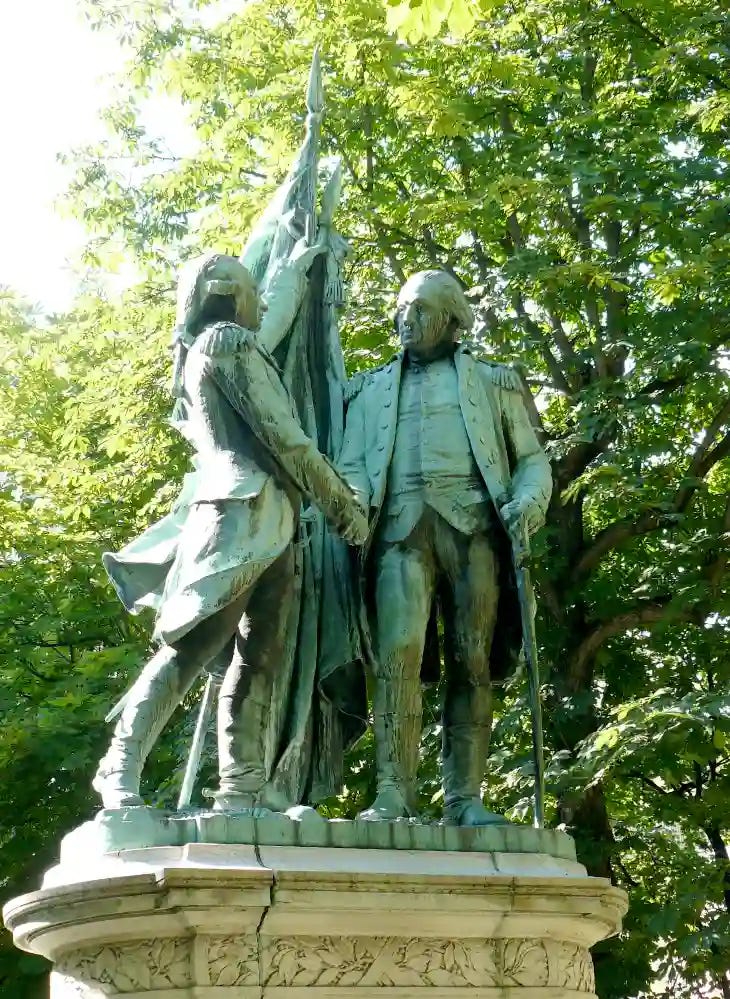
The Philadelphia Historical Society and the Alliance Francaise of Philadelphia are repositories of many Lafayette artifacts.
Picpus Cemetery is located at 35 Rue de Picpus, 75012 Paris, and is open weekday afternoons. Tel: + 33 1 43 44 18 54.
References:
Laura Auricchio, The Marquis: Lafayette Reconsidered, published 2014, Skylight Books. (The Vice President and Secretary of the John Simon Guggenheim Memorial Foundation, she previously served as Dean of Fordham College at Lincoln Center and Vice Provost for Curriculum and Learning at The New School, NYC.)
Gonzague Saint Bris, La Fayette, published 2006, Telemaque.
