

Père-Lachaise – Life Inside the Walls
LA FLÂNEUSE Of the 14 Paris cemeteries, Père-Lachaise is the largest, home to the humble and the great… and to its curator, Benoît Gallot, who actually lives there.

What is a flâneuse?
According to the Cambridge Dictionary, a flâneuse (or flâneur if a man) is someone who “walks around not doing anything in particular but watching people and society.”
Did anyone die today?
Benoît Gallot often heard his father ask the question. It made sense. Generations of the Gallot family owned and operated marbreries (monumental masonry for tombstones). Their daily business was… death. And business depended on… death. No wonder the 45-year-old Gallot is at ease in a setting where he is surrounded by the dead.
And the living. In addition to overseeing the 70,000 graves, and the columbarium with some 40,000 boxes, Gallot supervises the sale of burial plots, the upkeep of the grounds, and a staff of 80 workers ranging from gardeners to gravediggers.
A Bit of Background and a Publicity Stunt
Formerly called the Cimetière de l’Est, Père-Lachaise wasn’t always the hive of activity it is today – and its creation came about due to a quirk of history.
By the late 1700s, Paris cemeteries were so unsanitary that Napoléon ordered the Prefect of the Seine, Nicolas Frochot, to purchase a plot of land, Mont-Louis, whose only inhabitants had been a community of Jesuit priests. In fact, the cemetery is named after one of them, Père François de la Chaise, Louis XIV’s personal confessor.
Inaugurated in 1804, it was the first of several new cemeteries created around that time.
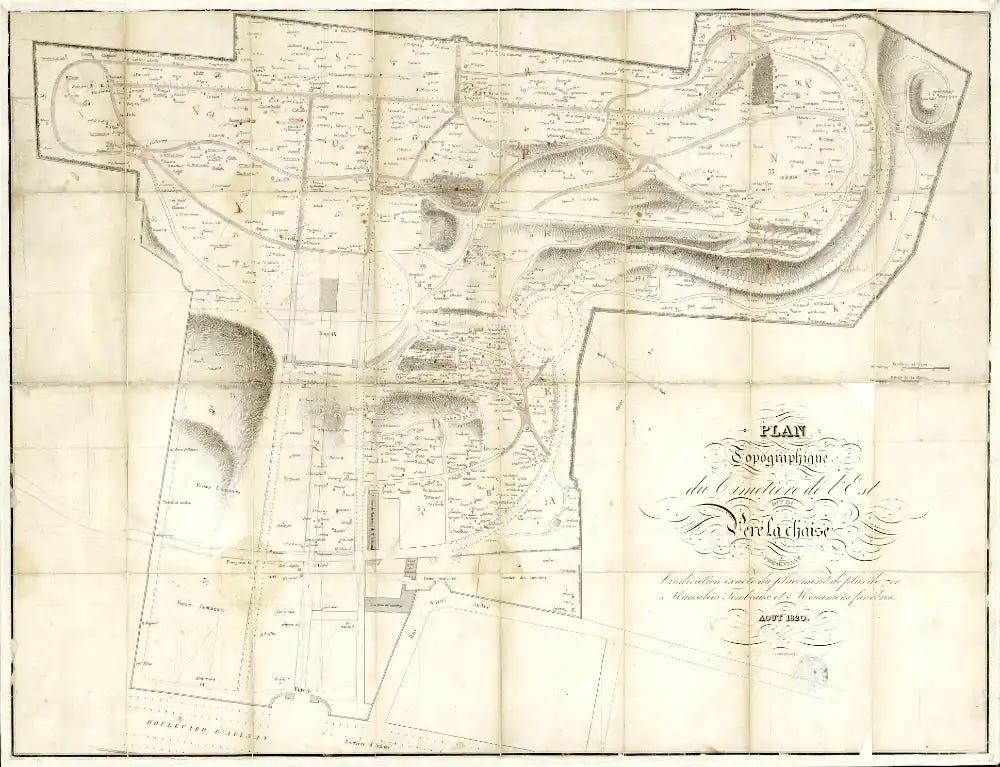
During the first year, there were only 13 graves, and growth was hardly exponential.
Fortunately, the administrators came up with a brilliant idea. Frochot arranged for the remains of Molière, Jean de la Fontaine, and Héloïse and Abélard to be transferred to the cemetery, with an official inauguration ceremony taking place on November 6, 1817.
Suddenly, the 110-acre spread became the place to be (dead).
Permanent Parisians
Celebrities such as Jean-Paul Sartre or the singer Dalida may rest in peace in Montparnasse or Montmartre, but for many, the Père-Lachaise remains the place to be. The tombs range from the unknown and unsung to the illustrious, including Sarah Bernhardt, Colette, Gertrude Stein, Alice B. Toklas, Isadora Duncan, Baron Haussmann, Maria Callas, Chopin, Delacroix, and Modigliani.
So, it’s hardly surprising that the necropolis attracts some 3.5 million visitors a year, of all nationalities, some of whom perform decidedly curious rituals.
Quirky Rituals and Odd Offerings
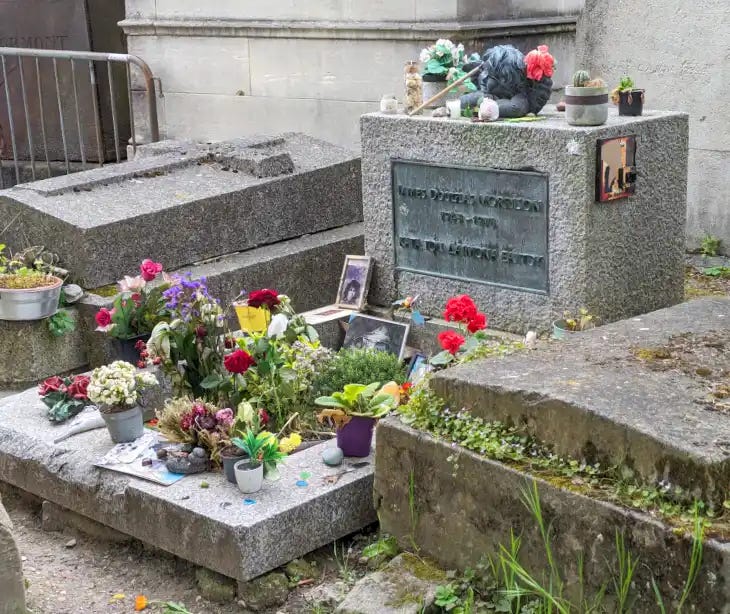
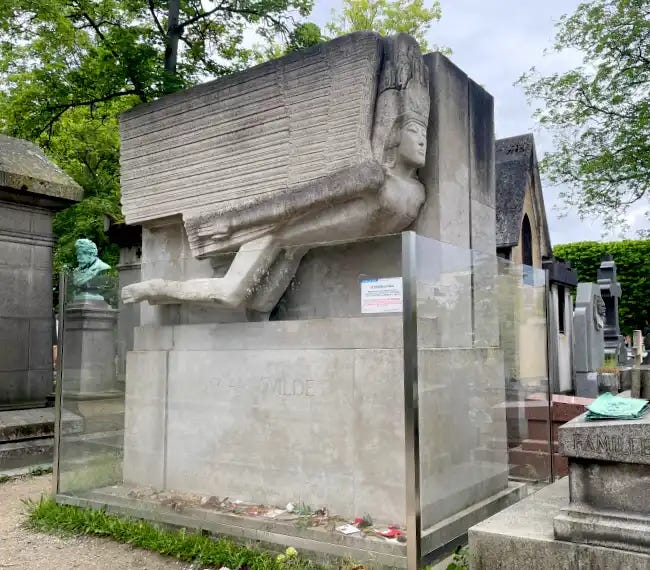
Fans of Doors singer Jim Morrison stuck so much chewing gum on a nearby tree that workers had to protect it with bamboo casing. Every year, the most devoted also make a pilgrimage to his tomb on the anniversary of his death. Elsewhere in the cemetery, Oscar Wilde devotees left so many kisses on the stone of the winged sphinx that the City of Paris installed a protective glass shield.
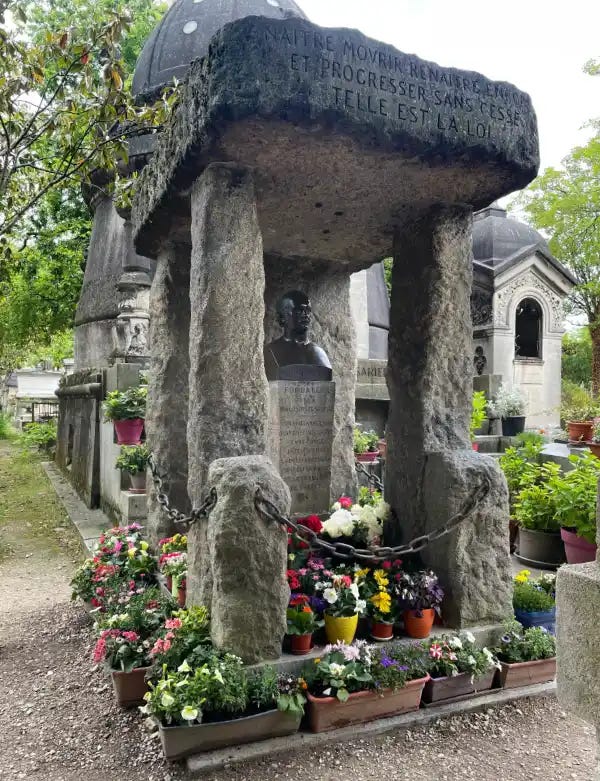
The father of spiritisme, Allan Kardec, told followers that after his death they should place their hands on the tomb and make a wish. If the wish was granted, they were to return with flowers. They still do – and the dolmen-shaped monument is constantly decorated.
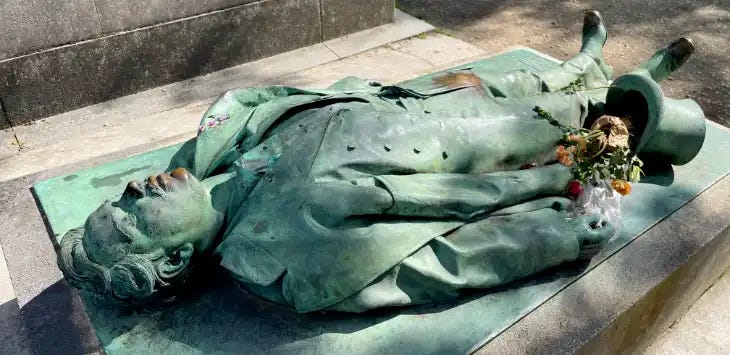
Admirers of Victor Noir, a 21-year-old opposition journalist assassinated by Pierre Bonaparte, go one step further. When they visit, they rub the recumbent’s particularly prominent private parts (said to procure fertility). I actually witnessed an entire group of young Spanish girls doing just that before running away red-faced and giggling.
Cobblestones, Cats, and Crows
After all the visitors are out and the gates are closed and locked, Gallot and his family are the only living humans who remain inside. His street address is, fittingly, Rue du Repos.
There’s an abundance of wildlife here though. During the calm of Covid, Gallot was surprised to see a fox cub. He snapped a picture before the animal ran away and, later, of the entire family. That led to his popular posts on Instagram, la_vie au_cimetiere, and a book, La vie secrète d’un cimetière (Les Arènes, Collection Proche, 2022), meaning ‘the secret life of a cemetery.’
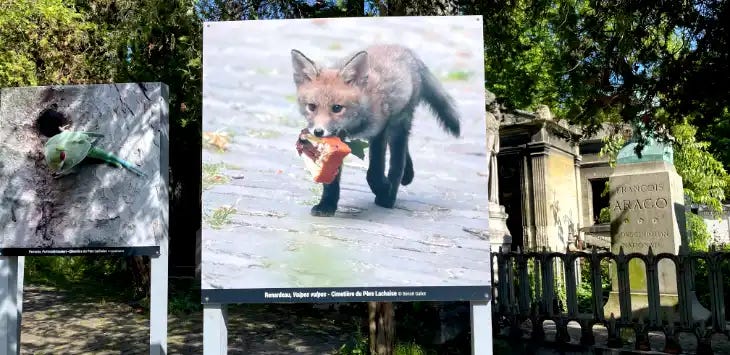
For a flâneuse, Père-Lachaise is a pedestrian paradise: winding cobblestone lanes, cats and crows, sculptural art, history… And for those who miss the closing bell while grave-spotting, there’s an emergency way out to rejoin the living.

Such a lovely description of Père-Lachaise cemetery. despite having visited many times, I didn’t know.
Had a wonderful time there, though it was only a few hours. I'll have to revisit. My favorite area was at the roundabout by the Tombe et Statue de Casimir Perier.